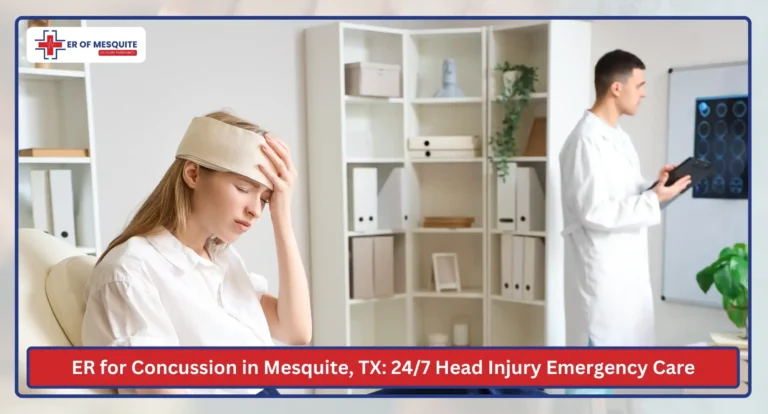
A head injury deserves proper evaluation, even when it appears minor at first. Concussion symptoms can be subtle, delayed, or mask something far more serious. ER of Mesquite offers 24/7 head injury evaluation with on-site CT scanning, board-certified emergency physicians, and no wait times. Walk in any time and leave with clear answers and a recovery plan.
What Is a Concussion?
A concussion is a traumatic brain injury caused by a bump, blow, or jolt to the head, or even a sudden whiplash motion that moves the brain inside the skull. It is classified as “mild” in medical terminology, but mild does not mean minor. A concussion temporarily disrupts how the brain functions, and without proper evaluation, complications can develop that are not visible from the outside.
Key Facts Every Patient Should Know
- A concussion can happen without losing consciousness. Most do not involve a blackout.
- A concussion can happen without striking the head directly. Whiplash from a car accident or sports tackle is enough.
- Symptoms can appear immediately or develop hours to days after the injury.
- Children and teenagers take longer to recover than adults.
- A second concussion before the first has healed can be far more dangerous than the original injury.
Concussion Symptoms to Watch For
Immediate Symptoms
- Confusion or feeling dazed
- Headache or pressure inside the skull
- Brief loss of consciousness, or no loss of consciousness at all
- Vomiting, especially in children
- Dizziness or balance problems
- Blurred or double vision, or sensitivity to light
- Ringing in the ears
- Memory loss around the time of the event
Delayed Symptoms (Hours to Days Later)
- Persistent headache that is not improving
- Difficulty concentrating or remembering
- Sleep changes, including sleeping too much, too little, or difficulty falling asleep
- Mood changes such as irritability, sadness, or anxiety
- Sensitivity to light or noise
- Slowed thinking or mental fog
- Fatigue out of proportion to activity
Symptoms in Children and Toddlers
Young children cannot always describe what they are feeling. Watch for behavioral and physical changes instead:
- Excessive crying or unusual fussiness
- Changes in eating or sleeping patterns
- Loss of interest in favorite toys or activities
- Loss of recently acquired skills, such as words or walking, in toddlers
- Unsteady walking or new balance problems
- Vomiting is always a serious sign in a child after a head injury
When to Come to the ER of Mesquite for a Head Injury
Walk in immediately when any of the following apply:
- Loss of consciousness, even briefly
- Vomiting, especially more than once
- Severe or worsening headache that is not improving
- Confusion, slurred speech, or memory loss
- Difficulty walking or balance problems
- Unequal pupil size or a pupil that does not react to light
- Seizure following the injury
- Drainage of clear fluid from the nose or ears
- Head injury in an infant, young child, or adult over 65
- Head injury in anyone with a history of blood-thinning treatment or bleeding disorders
- High-impact mechanism, including a motor vehicle accident, a fall from height, a sports collision, or a direct blow
When in doubt, come in. Head injuries are not the place to wait and see. Learn more about our no-wait ER in Mesquite.
When to Call 911 Instead of Driving
Some head injuries are too severe to be transported by car. Call 911 immediately for any of the following:
- Unresponsive or impossible to wake
- Active seizure
- Severe bleeding from the head that will not stop
- Open skull wound or visible bone
- Sudden severe neurological symptoms, including paralysis, complete vision loss, or inability to speak
- Neck pain after the injury suggests possible spinal involvement. Do not move the person.
- One-sided weakness or numbness developing after the injury
How ER of Mesquite Evaluates and Treats Concussions

Immediate Triage
You are triaged the moment you walk through the door. Vital signs, mental status, and visible injuries are assessed immediately to determine how urgently your situation needs to be addressed. There is no waiting room delay.
Neurological Examination
A board-certified emergency physician performs a complete neurological assessment covering mental status and memory, cranial nerve function, balance and coordination, reflexes, strength and sensation in the arms and legs, and pupil size and response.
Mechanism Review
Our physician asks detailed questions about how the injury occurred, including the speed and surface of impact, whether consciousness was lost, what the patient remembers or does not remember, and how symptoms have progressed since. This information directly shapes the evaluation and any imaging decisions.
On-Site CT Scanning
When imaging is clinically indicated, our CT scan is on-site, with results typically available within 15 to 30 minutes. No transfer to another facility is needed. CT imaging identifies brain bleeds, skull fractures, contusions, and other structural injuries that require immediate intervention.
When a CT Scan Is Ordered
Our physicians follow evidence-based guidelines to determine when imaging is necessary. A CT scan is typically ordered when:
- Loss of consciousness lasted more than a few seconds
- Vomiting has occurred more than once
- The headache is severe or worsening
- There is significant memory loss
- A skull fracture is suspected
- The patient is over 65
- The injury involved a high-speed or high-impact mechanism
- Any focal neurological symptom is present, such as weakness or slurred speech
When imaging is not needed, your physician will explain why and document the clinical reasoning.
Observation Services
Some patients need to be monitored for several hours to ensure symptoms are not evolving. Our emergency services include on-site observation so patients can be watched safely without requiring an inpatient hospital admission.
Discharge With a Clear Recovery Plan
Before you leave, you receive written concussion care instructions, specific warning signs that mean return to the ER immediately, activity restrictions for the following days, return-to-school and return-to-sport guidance, and a complete copy of your evaluation to share with your primary physician or specialist.
Hospital Transfer When Needed
If imaging reveals a brain bleed, skull fracture, or injury requiring neurosurgical care, we stabilize you at the ER of Mesquite first and coordinate ambulance transfer to the appropriate hospital.
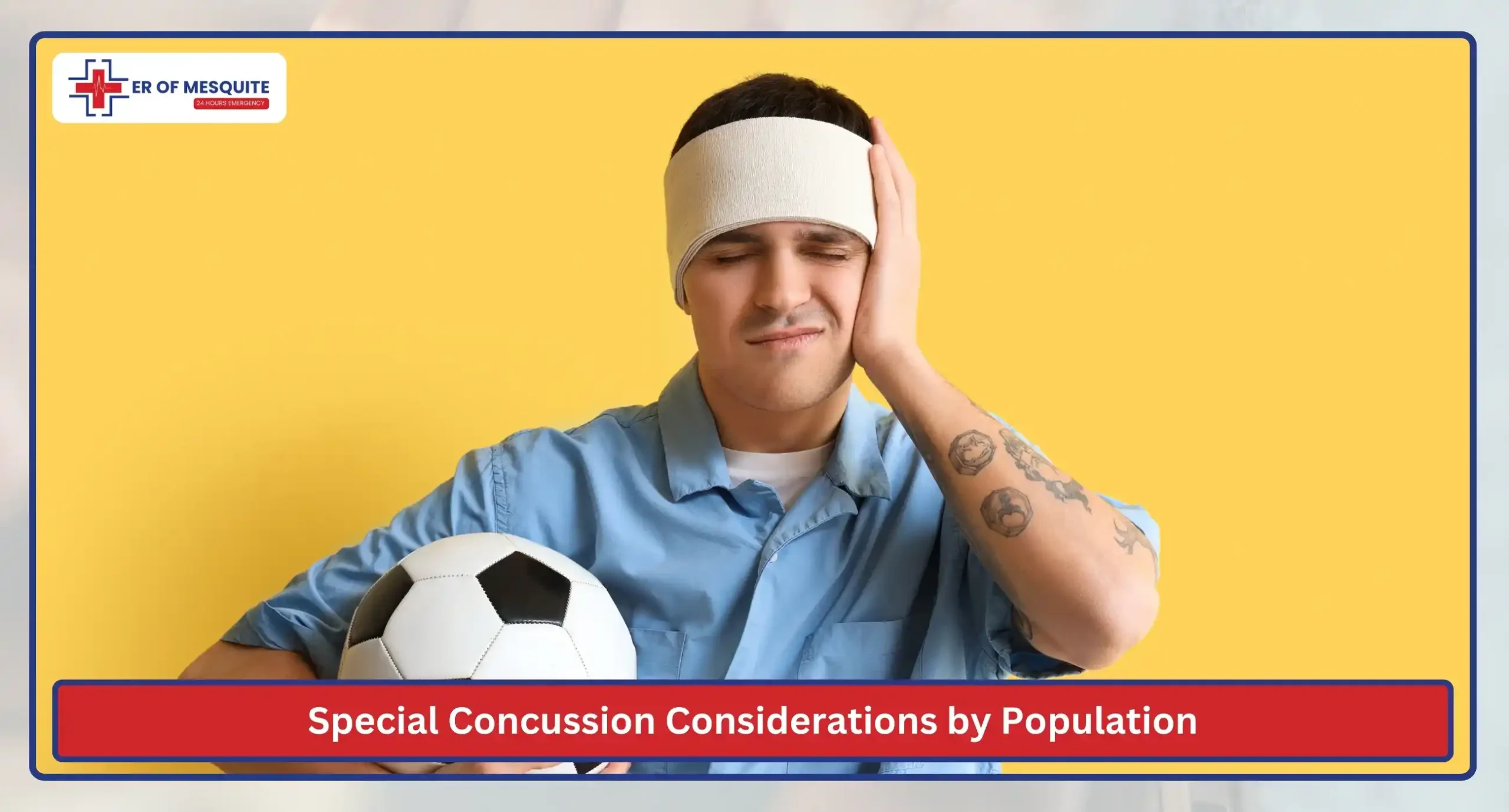
Special Concussion Considerations by Population
Children and Teenagers
Children take longer to recover from concussions than adults, sometimes weeks rather than days. They are also at higher risk for second impact syndrome, a rare but potentially catastrophic brain injury that occurs when a second concussion happens before the first has fully healed. Our pediatric emergency care team uses low-dose CT protocols and age-appropriate evaluation tools for patients of all ages, from infants to teenagers.
Athletes
Athletes across football, soccer, hockey, cheerleading, and other contact sports often minimize concussion symptoms to stay in the game. Returning to play too soon dramatically increases the risk of a second concussion. We provide written return-to-play guidance at discharge that athletes can take to their school, athletic trainer, or sports medicine physician.
Older Adults
Falls are the leading cause of head injury in adults over 65. Older patients face a significantly higher risk of slow brain bleeds, sometimes called subdural hematomas, which can appear days or even weeks after a seemingly minor fall. CT imaging is recommended at a lower threshold for this population.
Patients With Repeat Concussion History
Each concussion increases vulnerability to the next and extends recovery time. If you or your child has had a prior concussion within the last 6 to 12 months, mention it at triage. It directly affects how the evaluation and discharge counseling are approached.
Concussion Recovery: What to Expect
The First 24 to 48 Hours
Have someone stay with the patient during the first night. Watch for the following warning signs that require returning to the ER immediately:
- Worsening headache
- Repeated vomiting
- Increasing confusion or disorientation
- Difficulty waking the person
- New weakness or numbness on one side
- Seizure
- Slurred speech
Cognitive and Physical Rest
Limit screen time, intense reading, and demanding mental tasks. Avoid loud or bright environments. No sports or strenuous physical activity until cleared by a physician. Light walking is generally acceptable after the first day.
Recovery Timeline
Most adults recover within 7 to 14 days. Children and teenagers typically take 2 to 4 weeks. If symptoms, including headache, fatigue, or mental fog, persist beyond 3 months, evaluation for post-concussion syndrome by a neurologist is recommended.
Follow-Up Care
See your primary care physician within 3 to 7 days of your ER visit. If symptoms persist beyond 2 weeks, referral to a neurologist or concussion specialist is appropriate. Return to ER of Mesquite immediately if any warning signs develop during recovery.
Visit ER of Mesquite
Address: 1080 E Cartwright Rd, Suite 100, Mesquite, TX 75149 Phone: (469) 649-1007 Email: info@erofmesquitetx.com Hours: Open 24/7, every day of the year
We serve patients across Mesquite, Balch Springs, Sunnyvale, Forney, Garland, Seagoville, and surrounding communities. No appointment and no referral are ever required. If the injured person cannot be safely transported by car, call 911.
Frequently Asked Questions
How long after the injury can symptoms appear?
Symptoms can appear immediately, within hours, or even days after the injury. Watch closely for the first 48 hours, even if the person seems fine right after the impact.
Does every head injury need a CT scan?
No. Most minor head injuries do not require imaging. Our physicians use evidence-based decision tools to determine when a CT scan is truly necessary, balancing the small risk of radiation against the larger risk of missing a serious injury.
Can a concussion happen without losing consciousness?
Yes. Most concussions do not involve loss of consciousness. Confusion, headache, dizziness, vomiting, or memory issues after a head impact are all signs of a possible concussion, regardless of whether the person blacked out.
When can my child return to sports after a concussion?
Only after full clinical clearance from a physician. Returning too early significantly increases the risk of second impact syndrome. Athletes follow a graduated return-to-play protocol that we provide documentation for at discharge.