Most people searching for allergy help in Mesquite are looking for long-term management from a specialist. But some are searching with a swollen throat, a child having a reaction, or symptoms that are escalating fast. This guide explains when an allergic reaction crosses into emergency territory, what warning signs to never ignore, and how the ER of Mesquite treats severe allergic reactions 24/7 with no wait and no appointment needed.
Understanding the Spectrum of Allergic Reactions
Allergic reactions do not all look the same and they do not all require the same level of care. Understanding where your symptoms fall on that spectrum helps you make the right decision quickly.
Mild Reactions
Mild, stable reactions that are not worsening can typically be monitored at home with follow-up from your doctor or allergist:
- Sneezing, watery eyes, or mild nasal congestion
- Localized hives that are not spreading
- Mild itching without any swelling
- Mild stomach discomfort that resolves on its own
Moderate Reactions
These symptoms require professional evaluation. If they are worsening or not improving, go to the ER:
- Hives spreading across multiple areas of the body
- Mild facial swelling
- Nausea or vomiting following allergen exposure
- Mild throat irritation or tightness that is not resolving
Severe Reactions That Require Immediate ER Care
These are emergencies. Do not wait. Walk directly into ER of Mesquite or call 911:
- Swelling of the lips, tongue, throat, or face
- Difficulty breathing or wheezing
- Hives combined with vomiting and dizziness at the same time
- Rapid or irregular heartbeat
- Sudden drop in blood pressure, faintness, or loss of consciousness
- Confusion alongside other physical symptoms
- Any reaction that is rapidly worsening regardless of initial severity
For reactions involving breathing difficulty or loss of consciousness, call 911 immediately rather than driving.
What Is Anaphylaxis?
Anaphylaxis is a severe, whole-body allergic reaction involving multiple body systems simultaneously. It is not simply an intense version of a common allergic reaction. It is a medical emergency that can become life-threatening within minutes.
How Anaphylaxis Differs From a Typical Allergic Reaction
A typical allergic reaction is localized. It may produce hives in one area, a runny nose, or itchy eyes. Anaphylaxis affects two or more body systems at the same time, such as the skin and the respiratory system, or the digestive system and the circulatory system. This simultaneous involvement is what makes it dangerous and what distinguishes it from a reaction that can be safely observed at home.
Common Anaphylaxis Triggers
- Food allergies, particularly peanuts, tree nuts, shellfish, dairy, eggs, soy, and wheat
- Insect stings from wasps, bees, hornets, yellow jackets, and fire ants, all prevalent across North Texas
- Latex exposure from gloves, balloons, or medical equipment
- Environmental triggers in patients with severe sensitivities
- First-time allergen exposures with no prior known allergy history
Warning Signs of Anaphylaxis
Seek emergency care immediately for any combination of the following:
- Throat tightening or a sensation that the airway is closing
- Rapid swelling of the face, lips, or tongue
- Skin turning pale, bluish, or cool
- Sudden extreme fatigue or confusion
- Feeling of impending doom, which is a recognized clinical symptom of anaphylaxis
- Loss of consciousness
How ER of Mesquite Treats Severe Allergic Reactions
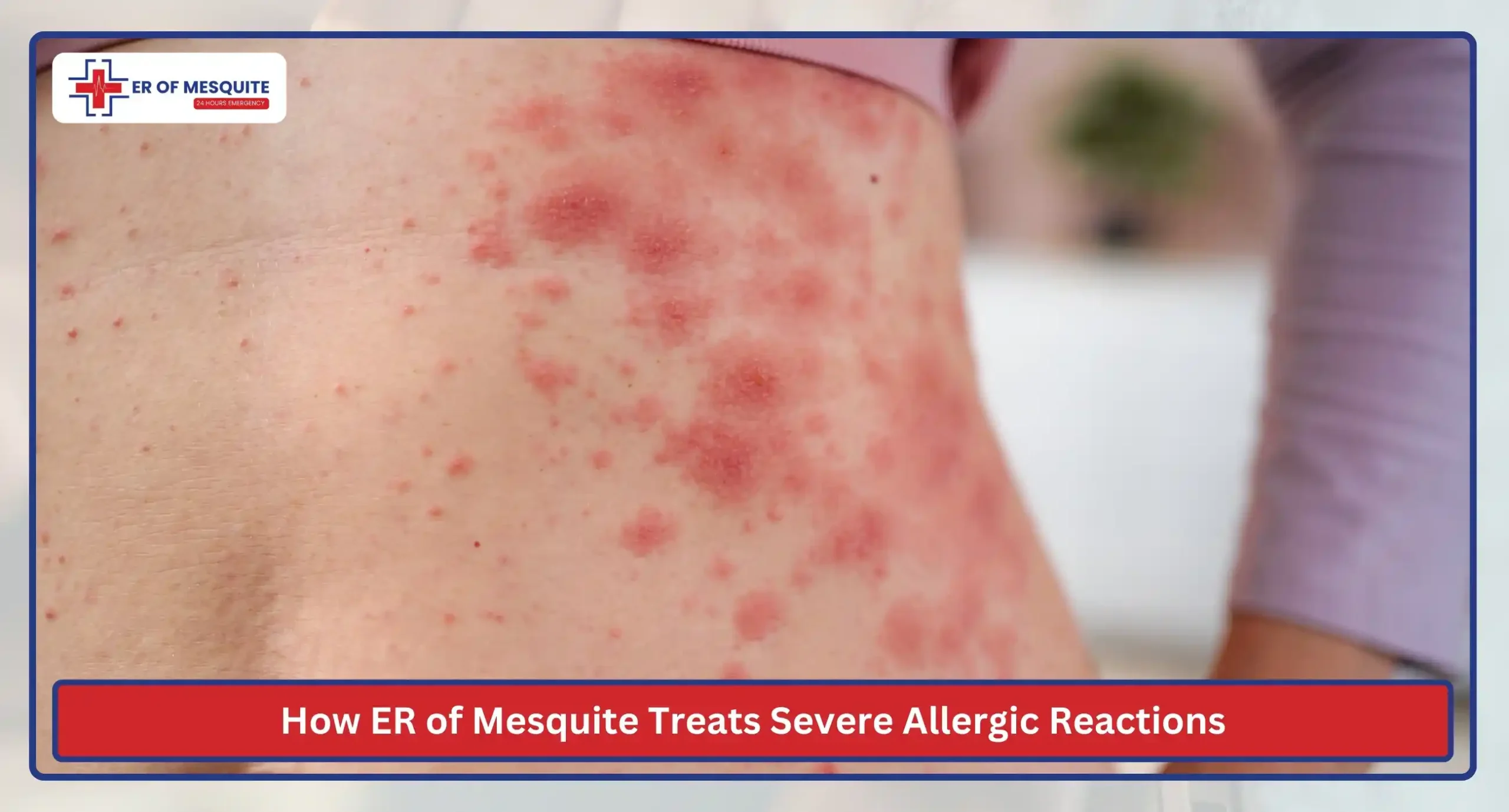
When you arrive at ER of Mesquite with a severe allergic reaction, our team responds immediately with a structured emergency protocol.
Immediate Assessment With No Wait
You are taken directly to a private treatment room from the moment you walk through the door. Our board-certified emergency physicians begin evaluating your airway, breathing, and circulation within minutes of arrival. There is no waiting room and no delay. Learn more about our no-wait ER in Mesquite.
Continuous Monitoring
Throughout your visit, our team monitors oxygen levels, heart rate, and blood pressure continuously. Severe allergic reactions can shift quickly, and close monitoring allows our physicians to respond to any change immediately.
IV Fluids and Stabilization
IV fluids are a key part of stabilizing patients experiencing severe allergic reactions, particularly when blood pressure has dropped or the patient is showing signs of circulatory compromise. IV access is established immediately upon arrival.
Observation for Delayed Reactions
Severe allergic reactions can return hours after the initial episode without any new allergen exposure, a phenomenon known as a biphasic reaction. After your symptoms are initially controlled, you are monitored for an extended period to confirm the reaction has fully resolved before discharge. This observation period is a critical part of safe emergency allergy care.
On-Site Diagnostics
Severe allergic reactions can overlap with or mimic other emergency conditions, including cardiac events. Our emergency lab testing and full on-site diagnostic capability allow our physicians to evaluate your complete clinical picture and rule out other causes rapidly.
Hospital Transfer When Needed
If your condition requires ICU-level monitoring or intensive care beyond what a freestanding ER provides, we stabilize you here first and coordinate ambulance transfer to the appropriate facility. You are never sent away without evaluation and treatment.
Discharge Planning
When you are stable and ready to leave, you receive a written action plan covering warning signs to watch for in the following 24 to 48 hours, clear guidance on what to do if symptoms return, and a recommendation to follow up with a board-certified allergist within 1 to 2 weeks.
After the ER: Why Allergist Follow-Up Matters
ER of Mesquite addresses the acute emergency. Identifying your triggers and preventing future reactions is the role of a board-certified allergist. Both are necessary, and one does not replace the other.
What an Allergist Does After an Emergency Visit
- Performs allergy testing to identify your specific triggers
- Confirms whether you are at ongoing risk for severe reactions
- Creates a personalized emergency action plan for daily life, school, work, and travel
- Evaluates whether long-term preventive treatment is appropriate for your situation
- Educates your household on avoidance strategies and recognizing early warning signs
The Right Sequence of Care
Emergency stabilization comes first. Long-term prevention follows. Schedule with a local allergist within two weeks of your ER discharge to complete the picture and reduce the risk of a future severe reaction.
Allergic Emergencies Commonly Seen in Mesquite
Our team treats severe allergic reactions from patients across Mesquite, Balch Springs, Sunnyvale, Forney, Garland, and Seagoville. Common presentations include:
- Food allergy reactions involving peanuts, tree nuts, shellfish, dairy, and eggs
- Insect sting reactions from fire ants, wasps, and hornets are all active across North Texas throughout the year
- Severe seasonal allergy escalations, particularly when combined with asthma flare-ups
- Skin reactions and rashes with rapid spread, swelling, or systemic symptoms
- First-time severe reactions in patients with no prior known allergy history
If you or your child is experiencing a moderate to severe allergic reaction, walk in immediately or call 911.
Address: 1080 E Cartwright Rd, Suite 100, Mesquite, TX 75149 Phone: (469) 649-1007 Hours: Open 24/7, every day of the year
We serve patients across Mesquite, Balch Springs, Sunnyvale, Forney, Garland, Seagoville, and surrounding communities. No appointment and no referral are ever required.
If you are experiencing breathing difficulty or loss of consciousness, call 911 rather than driving.
Frequently Asked Questions
Is ER of Mesquite an allergy clinic?
No. ER of Mesquite is a freestanding emergency room. We do not provide allergy testing, immunotherapy, or long-term allergy management. We treat severe allergic reactions and anaphylaxis 24/7 and guide patients toward allergist follow-up for ongoing care.
When should I go to the ER for an allergic reaction?
Go to the ER immediately if you experience throat or facial swelling, difficulty breathing, widespread hives combined with vomiting or dizziness, rapid heartbeat, faintness, or any reaction that is worsening rapidly. These are warning signs that require emergency evaluation, not a wait-and-see approach.
What is the difference between an allergic reaction and anaphylaxis?
An allergic reaction typically produces localized symptoms such as hives in one area or nasal congestion. Anaphylaxis involves two or more body systems simultaneously, such as the skin and the respiratory system together, and can become fatal within minutes without emergency treatment.