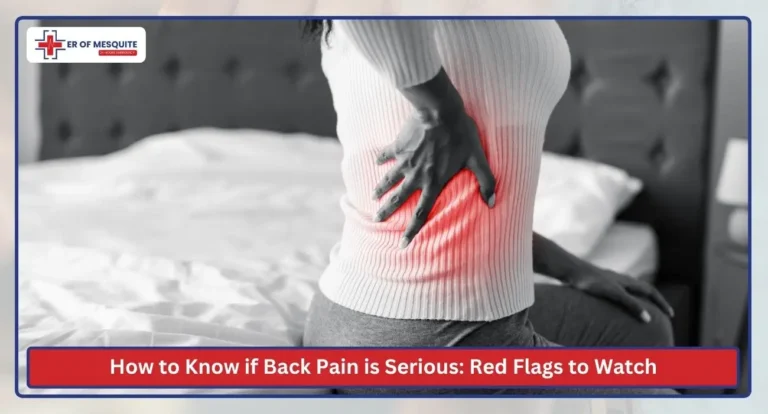
Most back pain fades on its own within days or weeks, but sometimes it signals nerve compression, infection, or a spinal injury that needs urgent care. Knowing how to know if back pain is serious can mean the difference between rest at home and preventing permanent nerve damage.
The warning signs are specific, they are well-documented, and they apply to almost every case. This guide walks through the red flags that turn ordinary back pain into a medical emergency, and what ER of Mesquite evaluates when they appear.
What Makes Back Pain Serious?
Back pain becomes serious when it comes with neurological symptoms, trauma, fever, or loss of bladder or bowel control. These are the classic red flags that shift back pain from a muscle problem into a possible nerve or systemic emergency requiring same-day evaluation.
Understanding how to know if back pain is serious starts with recognizing four categories of warning signs. Nerve involvement points to compression of the spinal cord or nerve roots. Trauma raises the risk of fracture, especially in older adults and patients on long-term steroids.
Fever paired with severe pain can indicate a spinal infection. And any change in bladder or bowel control is a surgical emergency until proven otherwise. Everything else, muscle strain, mild disc issues, poor sleep posture, usually improves at home with rest and time.
According to the National Institute of Arthritis and Musculoskeletal and Skin Diseases, most back pain resolves within a few weeks with self-care and does not require imaging or emergency evaluation (NIAMS Back Pain).¹
What Are the Back Pain Red Flags Doctors Look For?

Back pain red flags are specific warning signs that indicate a serious cause behind the pain. They fall into four groups: nerve involvement, cauda equina warning signs, systemic signs like fever or unexplained weight loss, and trauma-related patterns. Any single flag warrants same-day evaluation.
Nerve involvement
- Numbness or tingling in one or both legs
- Weakness in your legs or feet (progressive weakness is especially concerning)
- Radiating leg pain that shoots past the knee (sciatica)
- Trouble walking, unsteady gait, or foot dragging
Cauda equina warning signs (surgical emergency)
- Loss of bladder control or difficulty starting urination
- Loss of bowel control
- Saddle anesthesia (numbness in the groin, inner thighs, or buttocks)
- Rapidly worsening leg weakness on both sides
Systemic warning signs
- Fever with back pain
- Unexplained weight loss with new back pain
- History of cancer with new back pain
- Night pain that wakes you from sleep
Trauma-related warning signs
- Back pain after a car accident, fall, or heavy blow
- Pain in older adults after a minor fall
- Any pain following a high-impact injury
Two or more back pain red flags together mean walk in immediately.
When to Go to ER for Back Pain?
When to go to ER for back pain depends on whether any red flag applies. Walk in for loss of bladder or bowel control, leg weakness, saddle numbness, back pain after trauma, or fever with severe pain. Same-day imaging and neurological workup are needed.
Use this triage sequence:
- Any cauda equina sign (bladder or bowel control loss, saddle numbness, worsening leg weakness). Walk in now.
- New leg weakness, numbness, or radiating pain past the knee. Same-day ER evaluation.
- Back pain with fever, chills, or unexplained weight loss. Same-day ER evaluation.
- Back pain after trauma (fall, crash, hit). Walk in for imaging.
- Sudden severe pain in an older adult, patient on blood thinners, or someone with a cancer history. Come in.
Mayo Clinic notes that most back pain gets better with self-care within a few weeks (Mayo Clinic Back Pain), so pain without any of the criteria above can usually be monitored at home. Come in if it has not improved within two to three weeks or the pattern is changing.²
If you are still unsure how to know if back pain is serious in your case, err on the side of a walk-in evaluation. A short visit is a small cost compared to missing a diagnosis that damages nerves.
What Are the Serious Back Pain Symptoms and Their Likely Causes?

Serious back pain symptoms trace back to five main causes: cauda equina syndrome, spinal fracture, spinal infection, abdominal aortic aneurysm, and cancer-related spinal issues. Each has a distinctive pattern that shifts back pain from routine muscle strain to an emergency requiring imaging and immediate evaluation.
| Cause | Serious Back Pain Symptoms |
|---|---|
| Cauda equina syndrome | Loss of bladder or bowel control, saddle anesthesia, bilateral leg weakness |
| Spinal fracture | Sudden severe pain after fall, trauma, or minor injury in seniors |
| Spinal infection | Fever, severe local tenderness, worse at night, recent infection history |
| Abdominal aortic aneurysm | Sudden severe back and abdominal pain, cold clammy skin, fainting |
| Cancer-related spinal issues | New back pain in a patient with cancer history, night pain, weight loss |
| Kidney stones or infection | Sharp flank pain, painful urination, blood in urine |
| Herniated disc (severe) | Radiating leg pain past the knee with weakness or numbness |
Some of these overlap with other conditions our ER commonly evaluates, including severe abdominal pain and cases where dehydration accompanies severe pain, which our team also handles with IV rehydration when needed.
Who Is at Higher Risk of Serious Back Pain?
Higher-risk patients include adults over 65, patients on blood thinners, people with cancer history, immunocompromised patients, and those with recent infections or spinal surgery. New back pain in these groups deserves faster evaluation regardless of severity, because the underlying cause is more likely to be dangerous.
- Adults over 65 face higher fracture risk and higher aortic aneurysm risk
- Patients on blood thinners have a greater chance of spinal bleeding after minor injury
- People with cancer or a cancer history need same-day evaluation for any new back pain
- Recent infections or IV drug use raise spinal infection risk
- Immunocompromised patients may not show typical warning signs
- Recent spinal surgery or procedures require re-evaluation for any new pain
- Pregnant patients with severe pain need evaluation to protect mother and baby
If you are in any of these groups, do not wait for a red flag to appear before seeking care.
What Does ER Evaluation for Serious Back Pain Involve?

ER evaluation for serious back pain starts with a neurological exam checking strength, reflexes, and sensation, followed by imaging when red flags are present. Our board-certified physicians use on-site X-ray, CT scan, ultrasound, and full lab work to identify the cause fast and coordinate the next step.
At our emergency room in Mesquite, the workup for concerning back pain typically includes:
- Vital signs and a full history focused on the pattern, onset, and red flags
- Detailed neurological exam of the legs and pelvic nerves
- On-site imaging including digital X-ray, CT for detailed anatomy, and ultrasound for aortic evaluation
- Blood work for infection markers, kidney function, and inflammation
- Urinalysis if kidney stones or infection are suspected
If your evaluation reveals something that needs surgery or hospital admission, we stabilize you first and coordinate ambulance transfer to the right facility. If the cause turns out to be less serious, you go home with a clear diagnosis, home care instructions, and a follow-up plan.
We are open 24 hours a day, 7 days a week, with no appointment needed. Walk-in wait times are minimal.
Call 911 If You Have These Symptoms
Some back pain situations are too dangerous to drive to the ER. Call 911 right away for:
- Sudden severe back pain with fainting
- Back pain with severe abdominal pain and cold, clammy skin (possible aortic aneurysm)
- Loss of consciousness
- Suspected spinal injury after trauma. Do not move the person.
- Sudden paralysis or loss of feeling in the legs
- Back pain with severe chest pain
Location and Hours
ER of Mesquite, Cartwright
1080 E Cartwright Rd, Suite 100, Mesquite, TX 75149
📞 (469) 649-1007
🕒 Open 24/7/365, walk-ins welcome
We serve Mesquite, Balch Springs, Sunnyvale, Forney, Garland, Seagoville, and surrounding communities. We accept most major private (PPO) health insurance plans.
Texas Senate Bill 425 Disclosure: This facility is a Freestanding Emergency Medical Care Facility. It charges rates comparable to a hospital emergency room and may charge a facility fee. This facility, or a physician providing care here, may not be a participating provider in your health benefit plan network. A physician may bill separately from the facility. Under Texas law, your health insurance company is required to process emergency room visits at in-network benefit levels.
FAQs
How to know if back pain is serious enough for the ER?
Walk in for evaluation if you notice leg weakness, groin numbness, loss of bladder or bowel control, fever with pain, or back pain after trauma. These are the back pain red flags that require same-day ER care.
Can back pain be a sign of something life-threatening?
Yes. Serious back pain symptoms can point to abdominal aortic aneurysm, spinal infection, or cauda equina syndrome. All are treatable when caught early, but timing directly affects the outcome and the risk of permanent damage.
Why does back pain get worse at night?
Night pain that consistently wakes you from sleep can signal infection, tumor, or nerve compression. Normal muscle strain usually eases with rest, so persistent night pain warrants medical evaluation even without other red flags.
What if I hurt my back lifting something?
Most lifting injuries are muscle strains that resolve within days. Come in if you develop leg weakness, numbness, loss of bladder control, or rapidly worsening pain. When to go to ER for back pain after lifting depends on these signs.
Is it safe to drive myself with severe back pain?
If pain distracts you from driving or you have any neurological symptoms, have someone else drive. If you cannot safely move or have suspected spinal injury, call 911 instead of driving yourself.
When in Doubt, Get It Checked
Back pain is often minor, but the times it is not, delay costs you nerve function and recovery time. If any red flag applies, walk in to ER of Mesquite. Fast neurological evaluation, on-site imaging, and 24/7 emergency care under one roof.