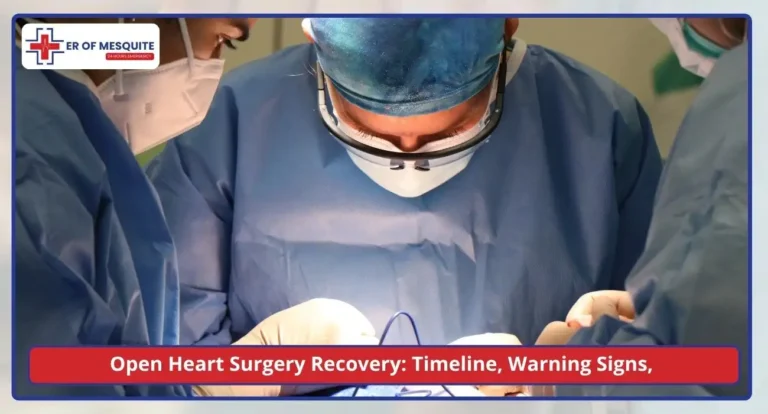
Open heart surgery recovery is one of the most demanding medical journeys a body goes through. Most patients spend 1-2 days in ICU, 4-5 more days in hospital, and 6-12 weeks healing at home. The hard part is knowing which symptoms are normal and which ones send you to the nearest ER.
Here is the honest timeline, the warning signs to watch, and how ER of Mesquite supports post-surgical patients 24/7
What to Expect After Heart Surgery
Healing after heart surgery unfolds in three phases: hospital recovery (5-7 days), early home recovery (weeks 1-6), and long-term healing (6-12 weeks and beyond). Each phase has specific milestones, physical limits, and warning signs that patients and caregivers should know by heart.
Per the Society of Thoracic Surgeons, most patients return to normal daily activities around 6-8 weeks after surgery, with full healing of the breastbone taking up to 12 weeks (STS What to Expect After Heart Surgery).¹
Three realities every patient should accept early:
- Healing is not linear. Good days and bad days are both normal.
- Fatigue lasts longer than expected. Mental and physical.
- Small warning signs matter. The sooner you flag them, the better the outcome.
Open Heart Surgery Recovery Timeline
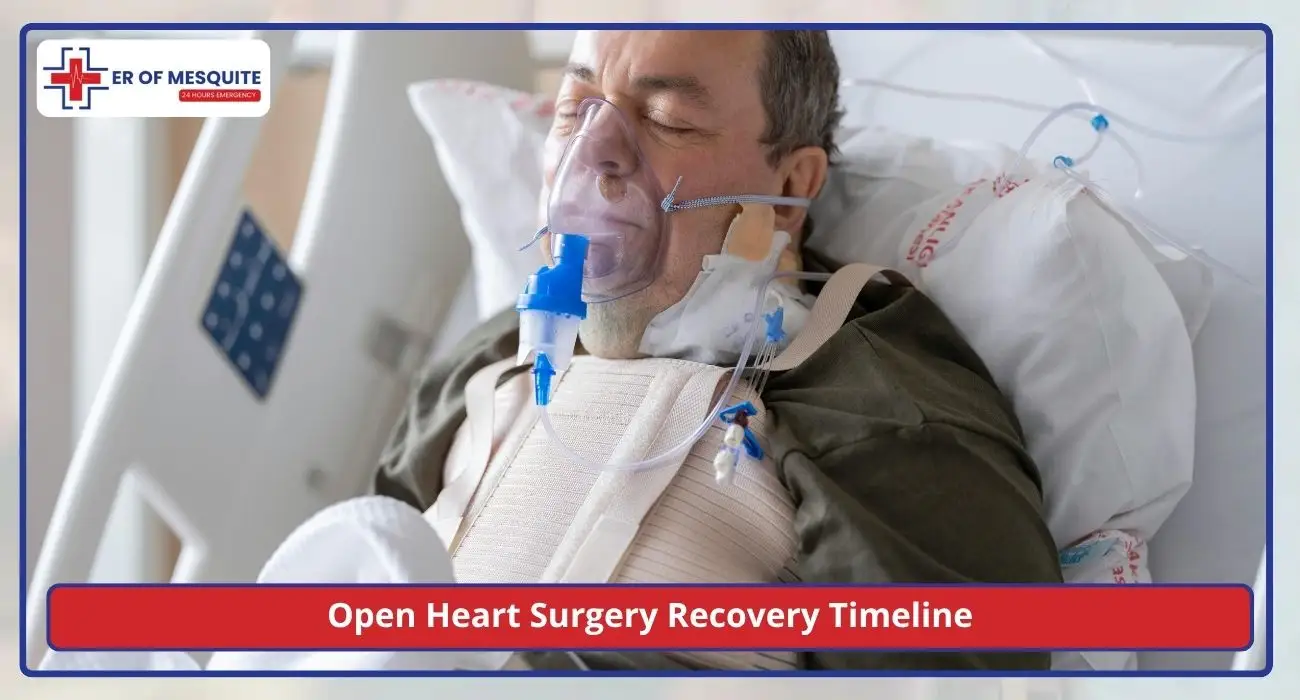
The open heart surgery recovery timeline moves in predictable phases. Hospital recovery lasts about a week, early home healing takes 1-6 weeks, and long-term progress continues for 3-12 months as the breastbone fully fuses and energy returns.
Days 1-7: Hospital Phase
| Day | What Happens | Key Milestones |
|---|---|---|
| Day 1 | ICU recovery, breathing tube removed | First sips of water |
| Day 2-3 | Moved to step-down unit | First walk, chair sitting |
| Day 4-5 | Walking longer distances | Discharge planning |
| Day 6-7 | Discharge home | Review of medications, incision care |
Pain is managed closely during this phase. Chest tube drains, catheters, and IV lines come out progressively.
Weeks 1-2: Early Home Phase
The first two weeks at home are the most carefully structured part of healing. Sternal precautions limit lifting (nothing over 5-10 pounds), driving is restricted, and showering requires careful incision drying.
- Short walks several times a day, gradually increasing distance
- Incision cleaning per surgical team instructions
- Sleep often disrupted by positioning restrictions
- Appetite may be reduced for 2-3 weeks
Chest soreness during this phase is normal, but it should not feel like the pre-surgery angina. Our guide on chest wall pain distinguishes incision-related muscle soreness from the deeper cardiac pain patterns that warrant immediate evaluation.
Weeks 3-6: Rebuilding Phase
Cardiac rehabilitation often begins around week 2-3. Energy slowly returns. Driving typically resumes around week 4-6 with surgical clearance. Walking distances increase. Emotional ups and downs are common and part of the healing process.
Weeks 6-12: Long-Term Healing
The breastbone finishes fusing. Most patients return to work (desk jobs around 6-8 weeks, physical jobs often 10-12 weeks). Cardiac rehab continues to build endurance. Full return of energy and stamina can take 3-6 months.
Normal Signs vs. Warning Signs
Healing includes some discomfort by design, but certain symptoms cross from normal into dangerous. Knowing the line protects you from both overreacting and dangerously underreacting.
| Symptom | Normal | Call Doctor / Go to ER |
|---|---|---|
| Incision soreness | Mild tenderness, improving daily | Increasing pain, red streaks, pus, warmth |
| Chest discomfort | Mild muscle ache with movement | Pressure, radiating pain, cold sweats |
| Fatigue | Tired after activity, improves with rest | Extreme exhaustion with mild activity |
| Breathing | Short of breath on stairs early on | Shortness of breath at rest or lying down |
| Appetite | Reduced for 2-3 weeks | Not eating or drinking for 24+ hours |
| Mood | Emotional ups and downs | Severe depression, suicidal thoughts |
| Swelling | Mild in legs or feet | Rapid swelling, especially one-sided |
| Fever | Low-grade in first week | 100.4°F+ after week one |
| Heart rhythm | Occasional skipped beat | Rapid, racing, or irregular heartbeat |
Per the NHLBI, most patients recover fully within 6-12 weeks but complications like infection, blood clots, or arrhythmias can appear suddenly even during a smooth recovery (NHLBI CABG Recovery).²
Red-Flag Symptoms That Need Emergency Care
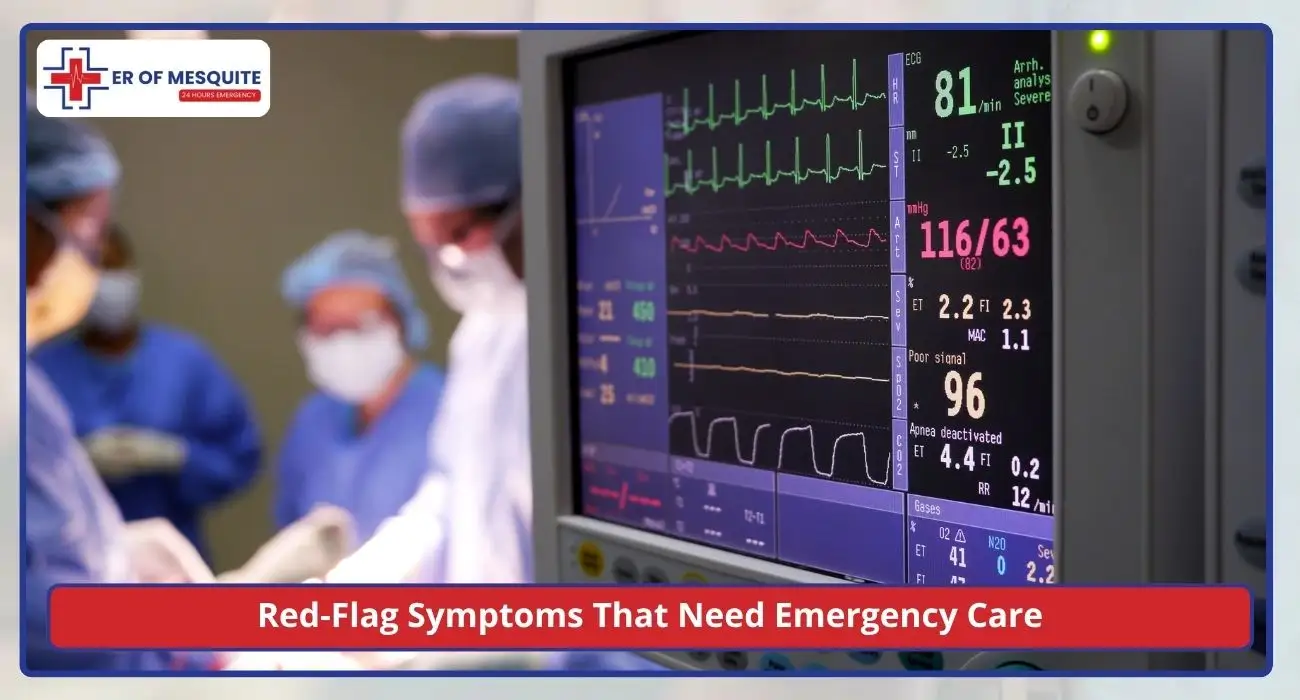
Any of the following symptoms during post-op healing means walk in to an ER or call 911 immediately. These signs can indicate sternal infection, blood clot, pericardial effusion, or a cardiac event, each needing rapid evaluation.
Walk in or call 911 immediately for:
Chest symptoms
- New chest pain, pressure, or tightness
- Chest pain radiating to arm, jaw, or back
- Suspected re-opening of the breastbone (clicking, grinding, pop)
Breathing symptoms
- Shortness of breath at rest
- Difficulty breathing while lying flat
- Rapid or labored breathing
Infection symptoms
- Fever above 100.4°F after week one
- Red, warm, or draining incision
- Spreading redness around the incision
Circulation symptoms
- One-sided leg swelling or calf pain
- Sudden numbness, weakness, or vision changes
- Fainting or near-fainting
Rhythm symptoms
- Rapid, racing, or irregular heartbeat lasting more than minutes
- Palpitations with dizziness
- Loss of consciousness
If any of these appear, our 24/7 emergency services in Mesquite can evaluate on-site rather than making you drive 30-45 minutes back to the surgical hospital in distress.
How to Support Open Heart Surgery Recovery at Home
Open heart surgery recovery at home succeeds with structured rest, consistent walking, proper incision care, cardiac rehab adherence, and emotional support. These habits reduce complication risk and shorten the full healing window.
Daily habits that help:
- Walk often, short distances. Start with 5-10 minutes several times a day. Gradually extend.
- Protect the breastbone. Follow sternal precautions for the full prescribed period, usually 6-8 weeks.
- Keep incisions clean and dry. Pat dry after showering. Watch for color changes.
- Eat small, nutritious meals. Appetite returns slowly. Protein supports healing.
- Sleep in a slightly inclined position. A recliner or extra pillows helps during the first weeks.
- Attend cardiac rehab. Studies consistently show it improves long-term outcomes.
- Take all medications as prescribed. Never skip or adjust without medical guidance.
- Accept help. Isolation slows healing. Mental health matters as much as physical.
Learning the benefits of a freestanding emergency room ahead of time means you know where to go fast if a complication appears, without the stress of researching options mid-crisis.
When to Go to ER After Heart Surgery: Our Role
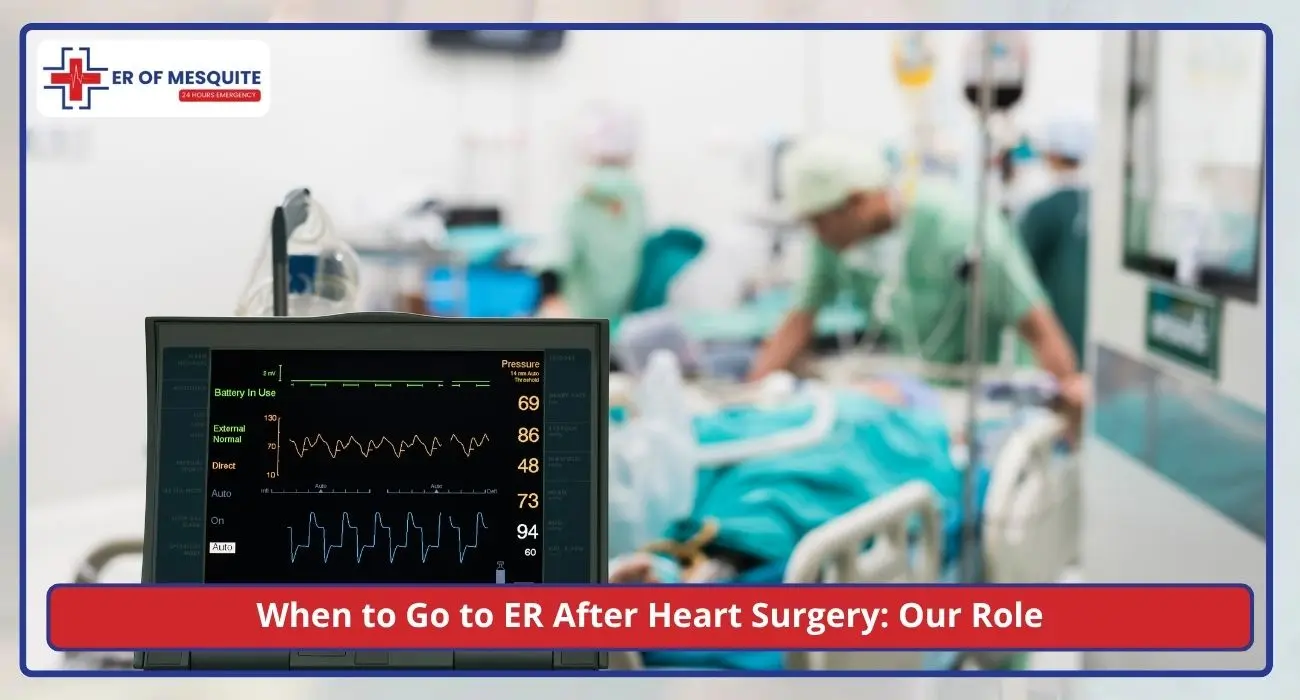
When to go to ER after heart surgery is any time a red-flag symptom appears, regardless of how recent the operation was. ER of Mesquite does not perform cardiac surgery, but we evaluate post-surgical complications, stabilize patients, and coordinate rapid transfer back to your surgical team when needed.
What our ER can do for post-surgery patients:
- Rapid evaluation with EKG within 10 minutes
- Cardiac blood work (troponin, D-dimer, inflammatory markers)
- On-site digital X-ray for sternal integrity and chest fluid
- CT scan for suspected pulmonary embolism or pericardial effusion
- IV fluids for dehydration or infection stabilization
- Infection control for sternal wound concerns
- Coordinated transfer back to your cardiac surgery team
For families in Mesquite and surrounding communities, having a 24/7 emergency option close by during the 6-12 week healing window is one of the biggest safety nets available.
Call 911 Immediately for These Signs
- Loss of consciousness
- Severe chest pain not relieved by rest
- Difficulty breathing or blue lips
- Suspected stroke (face droop, arm weakness, speech difficulty)
- Suspected sternal separation (clicking, grinding, popping)
- Severe one-sided leg swelling with chest symptoms
Do not drive yourself.
Location, Hours & Insurance
ER of Mesquite, Cartwright
1080 E Cartwright Rd, Suite 100, Mesquite, TX 75149
📞 (469) 649-1007
🕒 Open 24/7/365, walk-ins welcome
We serve Mesquite, Balch Springs, Sunnyvale, Forney, Garland, Seagoville, and surrounding communities. We accept most major private (PPO) health insurance plans.
FAQs
How long is the full open heart surgery recovery?
Most patients heal in 6-12 weeks, with the breastbone fully fused around week 12. Full energy and stamina usually return within 3-6 months, especially with cardiac rehab.
What is the hardest part of the open heart surgery recovery timeline?
Most patients find weeks 1-3 of the open heart surgery recovery timeline the hardest. Pain, sleep disruption, limited mobility, and emotional lows peak in these early weeks, then improve meaningfully by week 4.
When can I drive after heart surgery?
Most patients cannot drive for 4-6 weeks after surgery. Sternal healing and medication side effects affect reaction time. Your surgeon clears you based on healing progress and strength.
What are the warning signs during open heart surgery recovery at home?
During open heart surgery recovery at home, watch for new chest pain, fever above 100.4°F after week one, incision redness or drainage, one-sided leg swelling, shortness of breath at rest, and irregular heartbeat.
When to go to ER after heart surgery vs. call the surgeon?
When to go to ER after heart surgery is any time symptoms are severe, sudden, or clearly dangerous. Call the surgeon’s office for mild concerns during business hours. For red flags, do not wait, walk in or call 911.
Peace of Mind, Minutes Away
The healing journey is a long one, and knowing where to get fast expert care if something goes wrong matters as much as any home-care habit. ER of Mesquite is here 24/7 with on-site imaging, cardiac labs, and coordinated transfer back to your surgical team when needed.