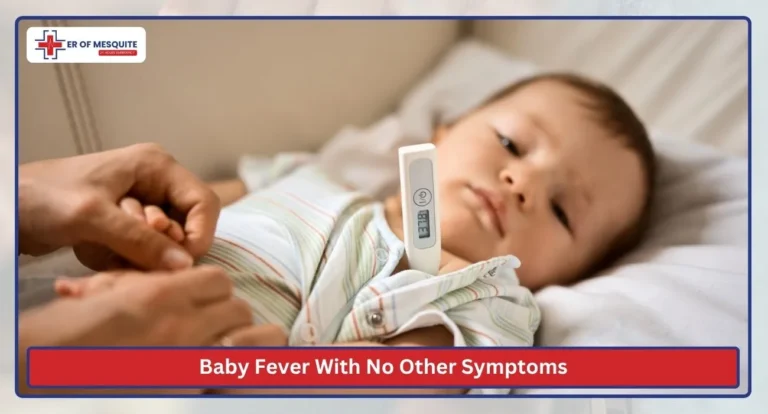
When a baby has a fever and looks otherwise fine, most parents feel less worried, not more. That instinct can be dangerous. In infants under three months, baby fever with no other symptoms is often the first and only sign of a serious infection, appearing before other clues show.
The American Academy of Pediatrics treats this scenario as urgent, and so should you. Here is exactly when to walk in to ER of Mesquite, by age.
Why Baby Fever With No Other Symptoms Can Be More Concerning, Not Less
Baby fever with no other symptoms often signals a serious bacterial infection that has not yet localized. The American Academy of Pediatrics classifies well-appearing febrile infants under 60 days as high-risk regardless of appearance, because urinary tract infections, occult bacteremia, and early meningitis can present with fever alone.
More than 10% of febrile infants aged 8 to 60 days have a urinary tract infection, and a small fraction have bacteremia or meningitis, per AAP guidance (AAP HealthyChildren). Newborn fever no other symptoms is often the only warning of neonatal sepsis, which is why the AAP standard is unequivocal.¹
Parents often wait for cough, rash, or congestion before seeking care. In the youngest babies, that wait costs time.
What Counts as a Fever in Babies by Age?
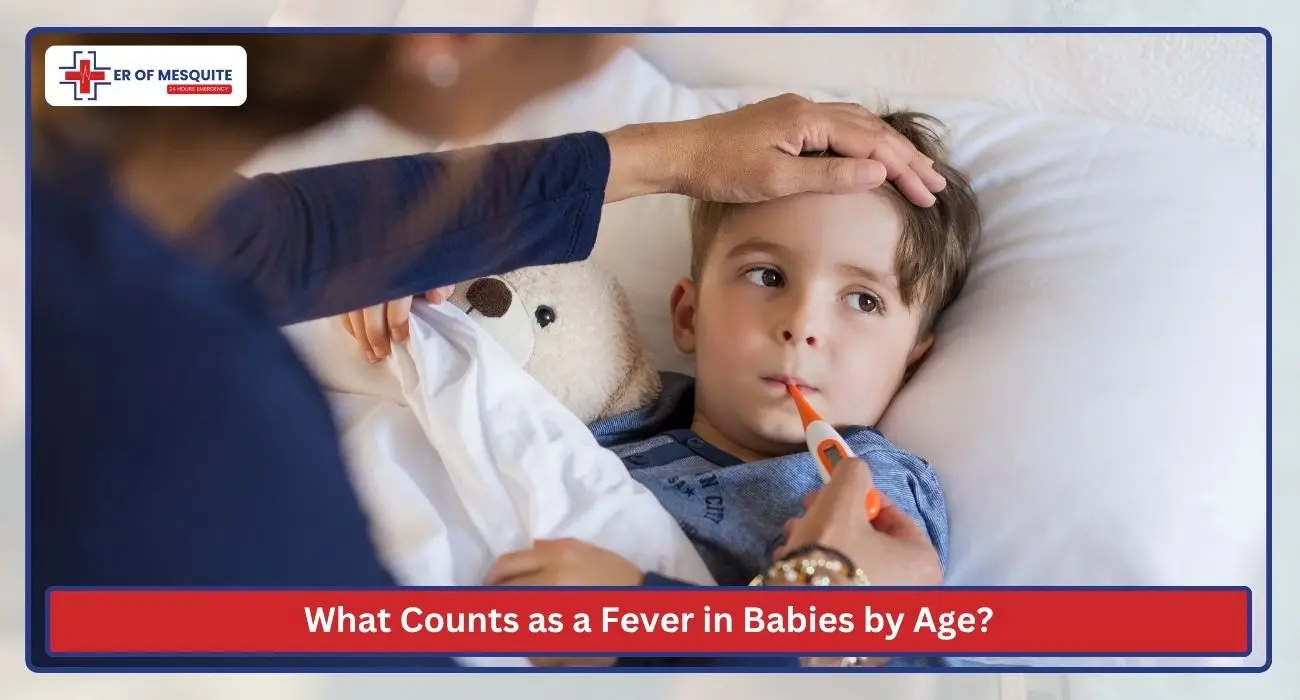
A fever in babies is a rectal temperature of 100.4°F (38°C) or higher. The Centers for Disease Control and Prevention uses this same cutoff (CDC infant care). Rectal thermometers are the most accurate method for infants, and this threshold applies whether the baby has other symptoms or not.²
| Age | Fever Threshold | Immediate Action |
|---|---|---|
| Under 3 months | 100.4°F rectal | Walk in immediately, no exceptions |
| 3 to 6 months | 101°F+ or unusual behavior | Same-day evaluation |
| 6 to 24 months | 102°F+ or persistent over 24 hours | Call or come in |
| Over 2 years | 104°F+ or lasting over 3 days | Evaluate |
Forehead and underarm readings can be convenient but give inconsistent results in young infants. Rectal is the standard under 3 months.
When to Go to ER for Baby Fever (Age-Based Triage)
When to go to ER for baby fever depends first on age. Under 3 months, any fever of 100.4°F or higher requires immediate ER evaluation. From 3 to 24 months, temperature and behavior matter together. Red-flag behavior always overrides the number.
Under 3 months (newborn fever no other symptoms is especially high-risk): Walk in immediately for any rectal temperature at or above 100.4°F. Newborn fever no other symptoms carries the highest risk in the first 30 days because immature immunity limits fever’s protective function.
3 to 6 months: Walk in for fever of 101°F or higher, or for any fever paired with unusual sleepiness, irritability that cannot be soothed, poor feeding, or dehydration signs.
6 to 24 months: Come in for fever of 102°F or higher, or for a lower fever lasting more than 24 hours without other symptoms developing.
Over 2 years: Evaluate for fever above 104°F or fever lasting more than three days. Also come in earlier for any concerning behavior change.
If you are still asking when to go to ER for baby fever in your specific situation, the safer answer is walk in.
What Can Cause Infant Fever No Other Symptoms?
Infant fever no other symptoms can be caused by hidden bacterial infections like UTIs and occult bacteremia, viral infections in the pre-symptom stage, ear infections, or early pneumonia. Vaccine reactions are also possible within 24 to 48 hours after immunization.
Understanding what causes infant fever no other symptoms helps parents know what our team tests first:
- Urinary tract infection, the top cause per AAP data. Our guide on emergency UTI care covers this in depth.
- Occult bacteremia, bacteria in the bloodstream before any other sign
- Viral infections like flu, RSV, and adenovirus, which can start with fever before congestion, cough, or rash
- Ear infections, not always obvious in babies who cannot describe pain
- Early pneumonia, sometimes presenting with fever before cough
- Meningitis, rare but critical, with irritability or lethargy as the only clue
- Post-vaccine reaction, usually mild and self-limiting within 48 hours
Warning Signs That Change Everything
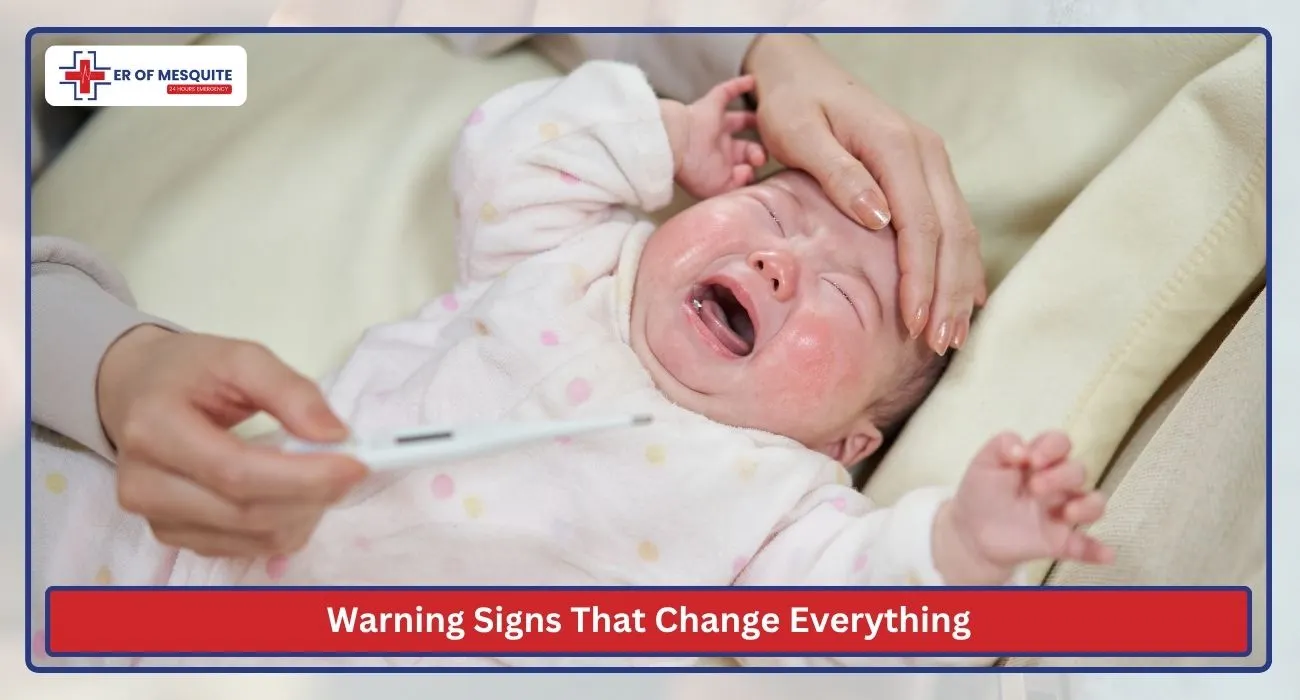
Even when the presentation is baby fever with no other symptoms, certain warning signs demand immediate ER care regardless of age or temperature. These signs point to sepsis, meningitis, or dehydration, and require action within minutes.
Behavior
- Unusual sleepiness or hard to wake
- Crying that cannot be comforted for over an hour
- Weak, high-pitched, or unusual cry
Breathing
- Fast or labored breathing
- Grunting sounds or chest pulling in around the ribs
- Blue or gray lips or fingertips
Feeding and hydration
- Refusing to feed for more than a few hours
- Dry mouth, no tears when crying
- Fewer than four wet diapers in 24 hours
Physical
- Purple or red rash that does not fade when pressed
- Stiff neck, bulging soft spot, or seizure
If you see any of these, walk in immediately, or call 911 for breathing difficulty, seizure, or unresponsiveness.
What Does the ER Do for a Febrile Baby?
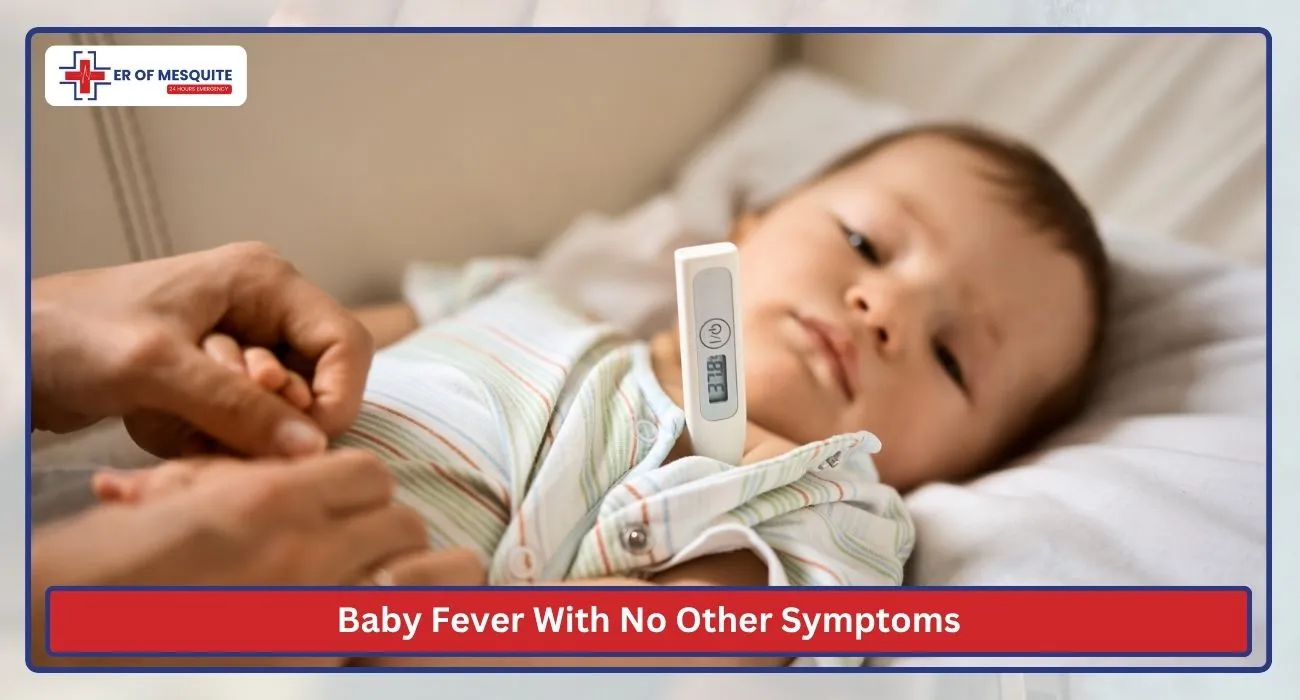
An ER evaluation for a febrile baby starts with a thorough exam by a board-certified physician, followed by focused testing to find the source of the fever. At our pediatric emergency room in Mesquite, the workup runs on-site with minimal wait times.
- Vital signs and history including age, exact temperature, feeding, and subtle behavior changes
- Head-to-toe exam looking for the fever source
- Urinalysis and urine culture to rule out UTI
- Blood work including complete blood count and inflammatory markers
- Chest X-ray if breathing is affected or pneumonia is suspected
- Rapid viral testing for flu, RSV, and COVID when relevant
- IV fluids if the baby is dehydrated
We coordinate transfer to a pediatric hospital when a lumbar puncture, admission, or specialist care is needed. Our emergency high fever treatment focuses on identifying the cause, not just lowering the temperature, and IV rehydration is available on-site for dehydration. For families weighing the ER against a hospital ED, the benefits of a freestanding emergency room include no wait times and pediatric-trained staff.
Call 911 If Your Baby Has Fever Plus Any of These
- Seizure
- Difficulty breathing, gasping, or blue lips
- Unresponsive or extremely limp
- Purple or red rash that does not fade under pressure
- Suspected meningitis (stiff neck, bulging soft spot)
Do not drive if the baby stops breathing or becomes unresponsive.
Location, Hours & Insurance
ER of Mesquite, Cartwright
1080 E Cartwright Rd, Suite 100, Mesquite, TX 75149
📞 (469) 649-1007
🕒 Open 24/7/365, walk-ins welcome
We serve Mesquite, Balch Springs, Sunnyvale, Forney, Garland, Seagoville, and surrounding communities. We accept most major private (PPO) health insurance plans.
Texas Senate Bill 425 Disclosure: This facility is a Freestanding Emergency Medical Care Facility. It charges rates comparable to a hospital emergency room and may charge a facility fee. This facility, or a physician providing care here, may not be a participating provider in your health benefit plan network. A physician may bill separately from the facility. Under Texas law, your health insurance company is required to process emergency room visits at in-network benefit levels.
FAQs
What temperature is considered a fever in babies?
A rectal temperature of 100.4°F (38°C) or higher is a fever in a baby. This threshold applies regardless of the child’s age, but the response varies significantly by age group.
My baby has fever with no other symptoms, should I worry?
If your baby is under 3 months old, yes. Any fever at or above 100.4°F needs immediate ER evaluation. For older babies, the temperature level and any behavior changes guide the decision.
Can teething cause a real fever in babies?
No. Teething may cause slight warmth or fussiness, not a true fever. If your baby has a rectal temperature of 100.4°F or higher, look for a medical cause, not teething.
What if my baby’s fever comes on after vaccines?
Post-vaccine fever is common within 24 to 48 hours and usually mild. In babies under 3 months, evaluate any post-vaccine fever the same way you would evaluate any other fever.
Should I give my baby fever reducer before coming to the ER?
Focus on getting the baby evaluated. Fever reducers can mask signs the physician needs to see. Never give fever reducers to a baby under 3 months without medical guidance.
When in Doubt With a Baby Fever, Walk In
Baby fever with no other symptoms is not a signal to relax. It is a signal to check the age, take the rectal temperature, and act on the guidelines. ER of Mesquite is open 24/7 with pediatric-capable staff and rapid on-site lab work when your baby needs answers fast.
External References Links :
1. (AAP HealthyChildren).
2. (CDC infant care)