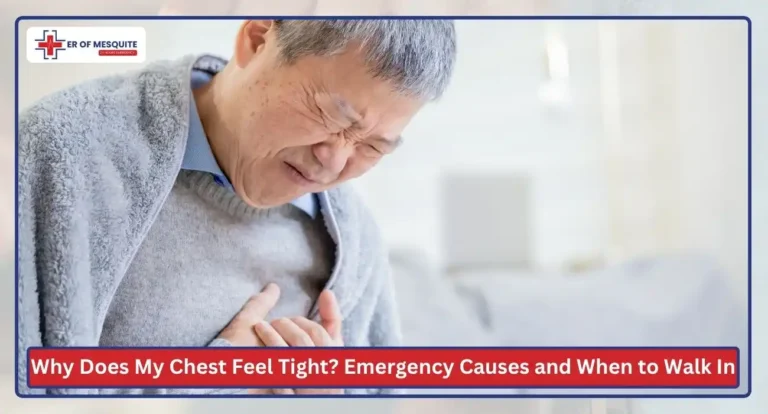
Why does my chest feel tight? It is the question that stops you in your tracks. Is this stress, heartburn, or a heart attack? Chest tightness is one of the most common symptoms in the emergency room, and the reason is simple: it can point to something minor or something life-threatening.
Here is what could be behind it, the warning signs that mean walk in now, and how ER of Mesquite evaluates chest tightness 24/7.
When Chest Tightness Is a Medical Emergency
Chest tightness becomes a medical emergency when it comes with shortness of breath, sweating, radiating pain, fainting, or a sense of impending doom. These signs point to acute coronary syndrome or pulmonary embolism, both of which require immediate ER evaluation. Time to treatment directly affects the outcome.
About 8 million adults visit US emergency departments each year for chest pain or tightness. Every case needs evaluation because the symptoms overlap between minor and life-threatening causes.
If your chest tightness started suddenly, worsens with rest, or comes with any other symptom, do not wait it out.
Chest Tightness Causes: What Might Be Behind It
Chest tightness causes range from heart and lung conditions to muscle strain and stress. The most common causes are anxiety, GERD (acid reflux), costochondritis, and angina. But heart attacks, pulmonary embolism, and pneumonia can also present with tightness that feels similar at first.
Heart-related causes:
- Heart attack (myocardial infarction)
- Angina (reduced blood flow to the heart)
- Pericarditis (inflammation around the heart)
- Aortic dissection (rare but critical)
Lung-related causes:
- Pulmonary embolism (blood clot in the lung)
- Pneumonia
- Asthma or COPD flare-up
- Collapsed lung
Digestive causes:
- GERD (acid reflux)
- Esophageal spasm
- Gallbladder disease
Musculoskeletal causes:
- Costochondritis (chest wall inflammation)
- Muscle strain or rib injury
Anxiety and stress causes:
- Panic attack
- Severe emotional stress
Chest wall pain from costochondritis or muscle strain can feel alarming but is usually not dangerous. Our related guide on chest wall pain explains the muscle-vs-cardiac distinction. Because these chest tightness causes overlap in how they feel, only a physical exam and testing can tell them apart reliably.
Chest Tightness Emergency Signs
Chest tightness emergency signs include sudden severe pressure, pain radiating to arm, jaw, back, or neck, shortness of breath, cold sweats, nausea, dizziness, or fainting. Any of these paired with tightness means walk in immediately or call 911. Women and diabetic patients may have subtler heart attack symptoms.
- Sudden, crushing chest tightness or pressure
- Pain radiating to arm, jaw, back, or neck
- Shortness of breath with the tightness
- Cold sweats or clammy skin
- Nausea or vomiting
- Fainting or feeling like you might pass out
- Rapid or irregular heartbeat
- Feeling of doom or extreme anxiety
- Tightness that does not improve with rest
- Tightness paired with fever, cough, or leg swelling
- Tightness with recent surgery, long travel, or bed rest (blood clot risk)
Per the American Heart Association, heart attack warning signs include chest discomfort, upper body pain, shortness of breath, and cold sweats (American Heart Association). MedlinePlus notes that women, older adults, and diabetics may feel little or no chest pain during a heart problem, so subtler chest tightness emergency signs like fatigue and nausea deserve equal attention (MedlinePlus).
When to Go to ER for Chest Tightness?
When to go to ER for chest tightness is easier than most symptoms to decide: if you are asking the question, come in. Chest tightness with any red flag needs an immediate ER visit. Chest tightness without other symptoms that lasts more than 15 minutes also warrants evaluation.
Walk in immediately for:
- Chest tightness with pain radiating to arm, jaw, back, or neck
- Chest tightness with shortness of breath, sweating, or nausea
- Sudden severe chest tightness that came on at rest
- Chest tightness in someone with heart disease, diabetes, or a family history
- Chest tightness after long travel, surgery, or bed rest
- Recurring chest tightness with mild exertion
- Chest tightness that will not go away after 15 minutes
Same-day evaluation for:
- New chest tightness in an adult over 40
- Chest tightness with any new heart symptom
- Chest tightness lasting hours to days
If you are still asking when to go to ER for chest tightness, the safer answer is walk in. The workup takes minutes.
Heart Attack vs. Anxiety vs. GERD Tightness
Heart attack, anxiety, and GERD can all cause chest tightness, but they have distinct patterns. Heart attack pressure often radiates to the arm or jaw. Anxiety comes with racing thoughts and tingling. GERD burns and worsens with lying flat. When the pattern is unclear, walk in for evaluation.
| Feature | Heart Attack | Anxiety Attack | GERD/Reflux |
|---|---|---|---|
| Onset | Sudden or gradual | Sudden, emotional trigger | Often after eating |
| Sensation | Pressure, squeezing, heaviness | Sharp, fluttery, breathless | Burning, sour taste |
| Radiation | Arm, jaw, back, neck | Localized | Rarely radiates |
| Improves with rest | Usually no | Usually yes | Improves sitting up |
| Sweating | Cold sweats | Warm, nervous sweat | No |
| Duration | Minutes to hours | Minutes | Minutes |
If you cannot tell which pattern you have, walk in. The workup takes minutes and gives you a definite answer.
What Does ER of Mesquite Do for Chest Tightness?

When patients come in asking why does my chest feel tight, our team runs an EKG within 10 minutes, cardiac blood work, chest X-ray, and CT scan on-site to distinguish heart attack, blood clot, and other serious causes from muscle strain or anxiety within the hour.
At our emergency room in Mesquite, the chest tightness workup includes:
- EKG within 10 minutes of arrival to rule out heart attack
- Vital signs, oxygen saturation, and rapid physical exam
- Cardiac blood work (troponin, complete blood count, D-dimer for clot risk)
- On-site digital chest X-ray for pneumonia, fluid, or lung issues
- CT scan on-site if pulmonary embolism or aortic issue is suspected
- Coordinated transfer to cardiology if a heart attack is confirmed
For chest tightness paired with high fever, our approach mirrors emergency high fever treatment. Learn more about the benefits of a freestanding emergency room for cardiac and respiratory emergencies.
Call 911 If You Have Any of These
Call 911 immediately for:
- Severe crushing chest pain or tightness lasting more than a few minutes
- Chest tightness with fainting or loss of consciousness
- Chest tightness with severe shortness of breath
- Chest tightness with cold clammy skin and blue lips
- Chest tightness in someone with known heart disease
- Suspected heart attack with any radiating pain
Do not drive yourself.
Location, Hours & Insurance
ER of Mesquite, Cartwright
1080 E Cartwright Rd, Suite 100, Mesquite, TX 75149
📞 (469) 649-1007
🕒 Open 24/7/365, walk-ins welcome
We serve Mesquite, Balch Springs, Sunnyvale, Forney, Garland, Seagoville, and surrounding communities. We accept most major private (PPO) health insurance plans.
Texas Senate Bill 425 Disclosure: This facility is a Freestanding Emergency Medical Care Facility. It charges rates comparable to a hospital emergency room and may charge a facility fee. This facility, or a physician providing care here, may not be a participating provider in your health benefit plan network. A physician may bill separately from the facility. Under Texas law, your health insurance company is required to process emergency room visits at in-network benefit levels.
FAQs
Why does my chest feel tight but there is no pain?
Chest tightness without sharp pain can still indicate serious conditions like angina, anxiety, or early pulmonary embolism. If tightness persists more than 15 minutes or comes with other symptoms, get evaluated.
Can stress alone cause chest tightness?
Yes. Panic attacks and severe anxiety can cause real physical chest tightness that mimics cardiac symptoms. But because the two overlap, the first episode should always be evaluated.
How long does chest tightness from a heart attack last?
Heart attack chest tightness usually lasts more than a few minutes and does not improve with rest. Angina episodes typically resolve within 5 to 15 minutes. Persistent tightness needs immediate evaluation.
Is chest tightness always a heart problem?
No. Many chest tightness cases turn out to be anxiety, GERD, or muscle strain. But because heart attack and pulmonary embolism can present similarly, evaluation is important the first time.
Should I drive to the ER with chest tightness?
If tightness is severe or paired with any warning sign, call 911. For mild tightness, have someone drive you instead of going alone. Never drive if you feel faint or short of breath.
Don’t Ignore Chest Tightness
If you are asking why does my chest feel tight, do not wait it out. The overlap between minor and life-threatening causes is exactly why chest tightness needs professional evaluation. ER of Mesquite offers EKG within 10 minutes, on-site imaging, and 24/7 walk-in care.