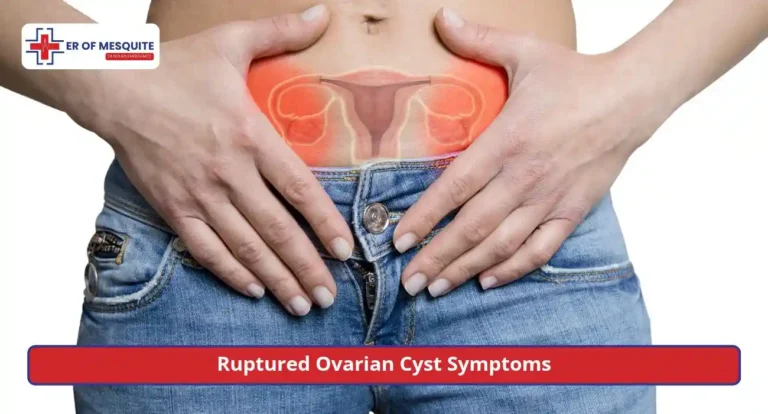
Medically reviewed by ER of Mesquite Medical Team
Ruptured ovarian cyst symptoms usually begin with a sudden sharp pain on one side of the lower pelvis, often during or after physical activity or intercourse. Most cysts rupture quietly and resolve on their own, but a smaller number cause internal bleeding or severe pain that needs emergency care. Knowing which pattern you have is the difference between resting at home with monitoring and walking in for same-day evaluation.
What Happens When an Ovarian Cyst Ruptures?
A ruptured ovarian cyst occurs when the wall of a fluid-filled sac on the ovary breaks open, releasing its contents into the pelvis. Most ruptures involve small functional cysts that heal without intervention. Hemorrhagic cysts or large endometriomas can bleed into the abdomen and cause severe pain.
Ovarian cysts are very common. Most women develop at least one during their reproductive years, and many rupture without ever being noticed. Symptoms range from a brief twinge to sudden, severe pain that mimics appendicitis.
Severity depends on three factors: size at rupture, whether it bleeds into the pelvic cavity, and whether blood vessels on the ovary are affected. Only an exam and imaging can tell which type you are dealing with.
Common Ruptured Ovarian Cyst Symptoms
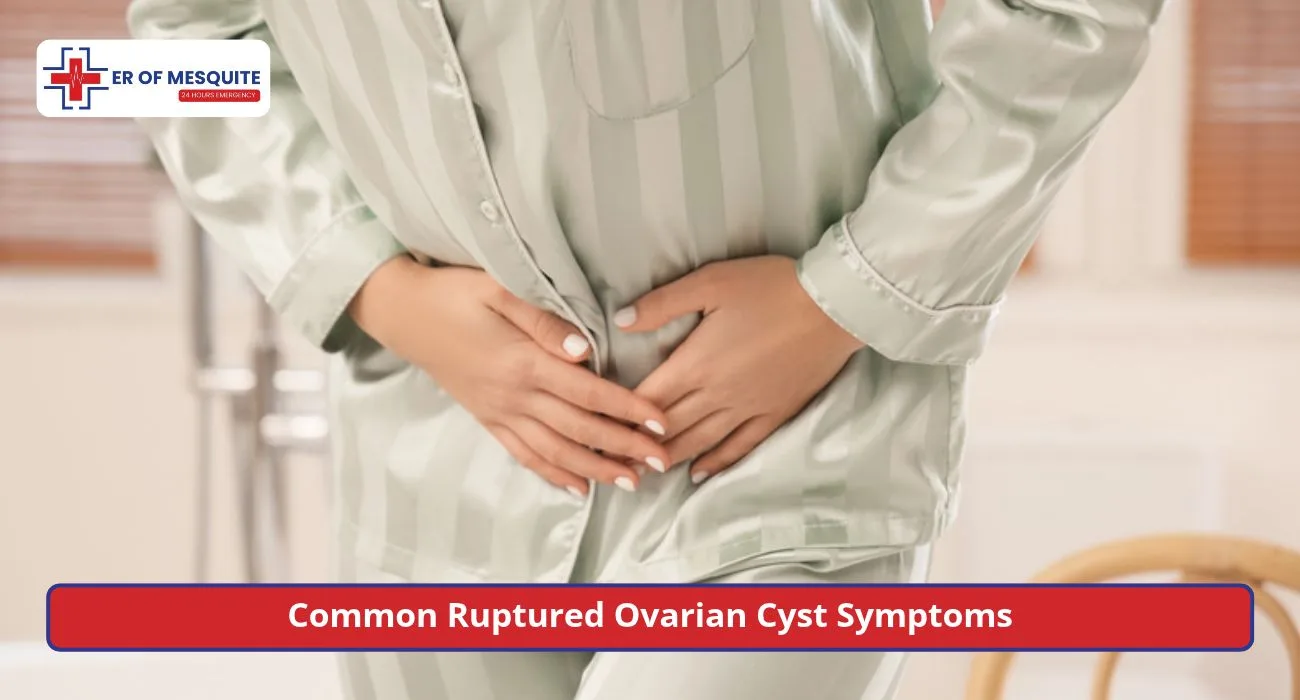
The most common ruptured ovarian cyst symptoms are sudden sharp or stabbing pain on one side of the lower pelvis, nausea, vaginal spotting, and a feeling of pressure or bloating. Pain often strikes during exercise, intercourse, or a bowel movement, and it may ease within hours or worsen steadily.
| Symptom | How It Typically Presents |
|---|---|
| Sudden sharp pelvic pain | One-sided, lower abdomen, often during activity |
| Pain radiating to lower back or thigh | Deep ache, worse with movement |
| Nausea or vomiting | Can start minutes after pain begins |
| Light vaginal spotting | Usually brown or pinkish, not heavy |
| Pelvic pressure or bloating | Feeling of fullness without clear cause |
| Pain during intercourse or bowel movement | Particularly on the affected side |
| Fatigue or lightheadedness | More concerning, may indicate blood loss |
| Shoulder pain | Rare, from blood irritating the diaphragm |
Per the American College of Obstetricians and Gynecologists, most ovarian cysts are benign and many resolve without treatment, but a small percentage lead to complications like rupture or torsion that require emergency evaluation (ACOG Ovarian Cysts). ¹
Ovarian Cyst Rupture Pain: What It Feels Like
Ovarian cyst rupture pain is often described as sudden, sharp, and one-sided, hitting the lower pelvis without warning. It can feel stabbing at first, then shift to a dull ache over hours. Movement, deep breathing, or pressure on the abdomen usually make it worse.
The pain pattern that points toward rupture:
- Sudden onset, often during activity, sex, or straining
- One-sided, in the lower left or lower right pelvis
- Sharp at onset, settling into a deep ache over 1-6 hours
- Worsened by movement, coughing, or bowel movements
- May radiate to the lower back, inner thigh, or rectum
Cyst pain is different from menstrual cramping, which is usually bilateral and timed with the period. Rupture pain is random, one-sided, and often strikes at mid-cycle. For families new to walk-in ER care, the benefits of a freestanding emergency room include shorter wait times and on-site ultrasound during a potentially urgent visit.
Ruptured Ovarian Cyst vs. Appendicitis: How to Tell
Ruptured ovarian cysts and appendicitis both cause sharp lower-abdominal pain and can be hard to tell apart without imaging. The key differences: appendicitis pain usually migrates from the belly button to the right side over hours, while cyst pain starts sudden and one-sided. ER imaging makes the final call.
| Feature | Ruptured Ovarian Cyst | Appendicitis |
|---|---|---|
| Onset | Sudden, often during activity | Gradual, over hours |
| Pain location | One side, lower pelvis | Starts central, migrates to lower right |
| Side | Can be either ovary | Almost always right lower quadrant |
| Fever | Rare or mild | Common, 99-101°F |
| Nausea | Common | Common |
| Timing with cycle | Often mid-cycle or before period | Unrelated to cycle |
| Pain pattern | Sharp then dull | Progressively sharper |
| Worsens over hours? | Often eases unless bleeding | Always worsens |
Because the two conditions overlap, our team evaluates both with on-site emergency abdominal pain workup including pelvic exam, ultrasound, and CT when needed. For patients whose pattern leans more toward right-lower-quadrant appendicitis, our emergency appendicitis care workflow runs the same hour-long diagnostic path. For upper-right abdominal pain that could point to liver issues instead, our guide on liver pain location maps the differences.
Ruptured Ovarian Cyst Warning Signs That Need the ER
Ruptured ovarian cyst warning signs that demand immediate ER care include severe pain that does not ease, dizziness, fainting, rapid heartbeat, pale skin, fever above 101°F, heavy vaginal bleeding, or signs of shock. These point to significant internal bleeding or complications like ovarian torsion.
Walk in immediately for:
- Severe pain that does not improve with rest
- Dizziness, lightheadedness, or near-fainting
- Fast heartbeat with pale, clammy skin
- Fever above 101°F with the pain
- Heavy vaginal bleeding beyond normal period flow
- Severe nausea and vomiting that will not stop
- Shoulder pain alongside pelvic pain
- Confusion or extreme weakness
- Pregnancy with severe pelvic pain (ectopic pregnancy must be ruled out)
The Office on Women’s Health notes that while most ovarian cysts cause no symptoms, severe or sudden pelvic pain combined with faintness or rapid heartbeat requires emergency evaluation to rule out rupture with bleeding or torsion (Office on Women’s Health Ovarian Cysts). Our full emergency services in Mesquite handle pelvic bleeding evaluation 24/7 with no appointment needed.²
When to Go to ER for Ovarian Cyst Concerns
When to go to ER for ovarian cyst pain depends on severity, blood loss signs, and ability to keep fluids down. Walk in for severe one-sided pelvic pain lasting more than 1-2 hours, pain with dizziness or fainting, heavy bleeding, or any pregnancy in combination with severe pain.
Walk in to the ER for:
- Any warning sign from the panel above
- Severe one-sided pelvic pain that will not ease
- Pain with pregnancy at any stage
- Pain in a patient with known ovarian cyst or history of rupture
- Pain with heavy bleeding
Same-day evaluation warranted for:
- Mild to moderate pain lasting more than a few hours
- Mild pain with new unusual bleeding
- Pain not responding to rest or warm compresses
- History of large cysts (over 5 cm)
Home monitoring may be appropriate for:
- Mild cramping that improves within an hour
- No fever, no bleeding, no dizziness
- No known high-risk cyst history
Pelvic pain in sexually active women of reproductive age also carries the risk of being an ectopic pregnancy, which is why a pregnancy test is almost always the first step in any ER workup. Our emergency UTI care also covers overlapping pelvic pain presentations that complicate the differential.
What ER of Mesquite Does for Suspected Ovarian Cyst Rupture

Our ER evaluation for suspected ovarian cyst rupture begins with vital signs, pelvic exam, and a pregnancy test, followed by on-site ultrasound and blood work to assess for internal bleeding. If significant hemorrhage or torsion is suspected, we stabilize and coordinate rapid transfer to an OB-GYN surgical team.
The workup includes:
- Vital signs including blood pressure and heart rate (monitoring for shock)
- Pregnancy test (always first in reproductive-age patients)
- Pelvic exam checking for one-sided tenderness and masses
- Complete blood count to screen for internal bleeding
- On-site pelvic or transvaginal ultrasound
- CT scan when ultrasound is inconclusive
- IV fluids and pain management for severe cases
- Coordinated OB-GYN transfer if surgical intervention is required
ER of Mesquite does not perform gynecological surgery on-site. For patients with severe bleeding or nausea while waiting for specialist care, our IV rehydration support keeps you medically stable during the handoff.
Call 911 Immediately for These Signs
- Loss of consciousness
- Severe dizziness that keeps you from standing
- Rapid pulse with cold, clammy skin (possible shock)
- Severe uncontrolled bleeding
- Severe pain with pregnancy at any stage
- Rigid, board-like abdomen with severe pain
These suggest significant internal bleeding, shock, or ectopic pregnancy complications, all of which need pre-hospital stabilization.
Location, Hours & Insurance
ER of Mesquite, Cartwright
1080 E Cartwright Rd, Suite 100, Mesquite, TX 75149
Phone: (469) 649-1007
Hours: Open 24/7/365, walk-ins welcome
We serve Mesquite, Balch Springs, Sunnyvale, Forney, Garland, Seagoville, and surrounding communities. We accept most major private (PPO) health insurance plans.
FAQs
What are the earliest ruptured ovarian cyst symptoms?
The earliest signs are a sudden sharp pain on one side of the lower pelvis, often during physical activity or intercourse, followed by nausea, pressure, or light spotting within hours of the pain starting.
How long does ovarian cyst rupture pain last?
Ovarian cyst rupture pain typically eases within 24-48 hours as the released fluid is absorbed. If pain worsens, radiates, or comes with dizziness or fever after the first hours, come in for evaluation.
When to go to ER for ovarian cyst pain?
When to go to ER for ovarian cyst pain is immediate for severe one-sided pelvic pain, dizziness, fainting, heavy bleeding, fever over 101°F, or any pregnancy combined with pelvic pain. Milder cases can be evaluated same-day.
Can a ruptured ovarian cyst be mistaken for something else?
Yes. Ruptured ovarian cysts share symptoms with appendicitis, ectopic pregnancy, ovarian torsion, kidney stones, and pelvic infections. Imaging and blood work are usually needed to distinguish them.
Will I need surgery after a ruptured ovarian cyst?
Most ruptured ovarian cysts heal without surgery. Surgery is considered only when significant bleeding, torsion, or very large cysts are present. Our ER evaluates imaging and labs to determine if surgical coordination is needed.
When the Pain Is Severe, Do Not Wait at Home
A ruptured ovarian cyst can resolve quietly or cause internal bleeding that needs emergency care. If your pain is severe, one-sided, or paired with dizziness, nausea, or any warning sign, walk in to ER of Mesquite. On-site ultrasound, labs, and 24/7 care give you a definite answer within the hour.