Medically reviewed by ER of Mesquite Medical Team
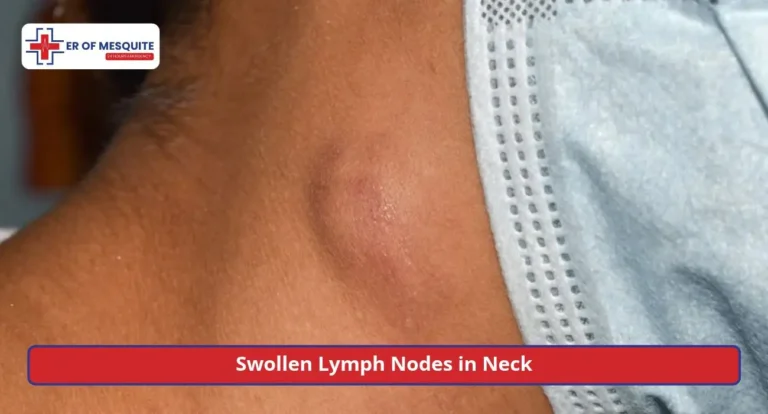
Swollen lymph nodes in neck are one of the most common reasons people search their symptoms online. Most cases turn out to be minor.
The body builds lymph nodes anytime it fights an infection. A cold, strep throat, or ear infection can produce a tender lump within hours.
A smaller number of cases point to something more serious. Knowing what to feel for separates a normal immune response from a reason to walk in.
Why Do Lymph Nodes Swell in the First Place?
Lymph nodes are small immune filters along the neck, under the jaw, behind the ears, and down the collarbone. They swell when white blood cells rush in to attack bacteria, viruses, or abnormal cells.
A single enlarged node after an illness is almost always a sign the immune system is doing its job.
Three things determine whether the swelling matters: what caused it, how long it lasts, and what the node feels like under your fingers. The most common cause is a recent infection in the head and neck.
Less common causes include autoimmune conditions, medication reactions, and in rare cases, cancer.
How to Feel and Evaluate a Neck Lymph Node

Checking a lymph node takes about a minute. Use the pads of your index and middle fingers (not fingertips) and press gently in small circles along each side of the neck.
Check under the jaw, in front of and behind the ears, down the sides of the neck, and above the collarbones.
| Feature to Check | Likely Benign | Potentially Concerning |
|---|---|---|
| Size | Pea-sized (under 1 cm) | Over 1 inch (2.5 cm) |
| Texture | Soft to rubbery | Hard or stony |
| Movement | Moves freely under skin | Fixed, stuck to tissue |
| Pain | Tender to touch | Painless |
| Growth | Stable or shrinking | Rapidly growing |
| Duration | Resolves in 1-4 weeks | Persists over 4-6 weeks |
| Location | Both sides, with illness | One-sided, above collarbone |
| Skin above | Normal | Red, warm, draining |
Per the American Academy of Otolaryngology, any neck mass in an adult lasting more than two weeks warrants evaluation to rule out malignancy (ENT Health Neck Mass Evaluation).¹
Swollen Lymph Nodes in Neck Causes by Risk Level
Swollen lymph nodes in neck causes fall into three broad risk groups. Low-risk causes are everyday infections that resolve on their own.
Moderate-risk causes need medical evaluation but are rarely dangerous. High-risk causes include deep infections and uncommon conditions like lymphoma that need prompt workup.
Low-risk (resolve in 1-4 weeks):
- Common cold or upper respiratory infection
- Ear infection or mild sinusitis
- Minor dental infection
- Reactive node after a scalp or skin irritation
- Allergic reaction or bug bite
Moderate-risk (need evaluation):
- Strep throat (needs testing and antibiotics)
- Mononucleosis (prolonged fatigue, large tender nodes)
- Tonsillitis with heavy pain
- Severe dental abscess
- Autoimmune flares (lupus, rheumatoid arthritis)
Higher-risk (walk in or see specialist):
- Deep bacterial infection with fever and spreading redness
- Persistent one-sided node over 2 weeks
- Supraclavicular node (above collarbone) at any size
- Painless, hard, fixed node
- Multiple persistent nodes with weight loss or night sweats
If the swelling comes with high fever, our emergency high fever treatment workflow runs rapid strep, mono, and blood work on-site.
Normal vs. Concerning Characteristics
A normal reactive node and a concerning one often feel completely different. The combination of texture, movement, location, and growth pattern separates them more reliably than size alone.
| Characteristic | Normal Reactive | Concerning |
|---|---|---|
| Timing | During or after illness | Without illness |
| Tenderness | Painful when pressed | Painless |
| Firmness | Soft and springy | Hard, rubbery, stony |
| Mobility | Rolls under finger pressure | Does not move |
| Growth rate | Peaks then shrinks | Grows steadily over weeks |
| Side | Bilateral or infection side | One-sided, no cause |
| Systemic signs | Sore throat, cold, earache | Weight loss, night sweats |
| Duration | 1-4 weeks | Over 4-6 weeks |
For lumps near the collarbone that might feel connected to the chest, our chest wall pain guide covers the neck-to-chest boundary.
Swollen Lymph Node on One Side of Neck: Is It Different?
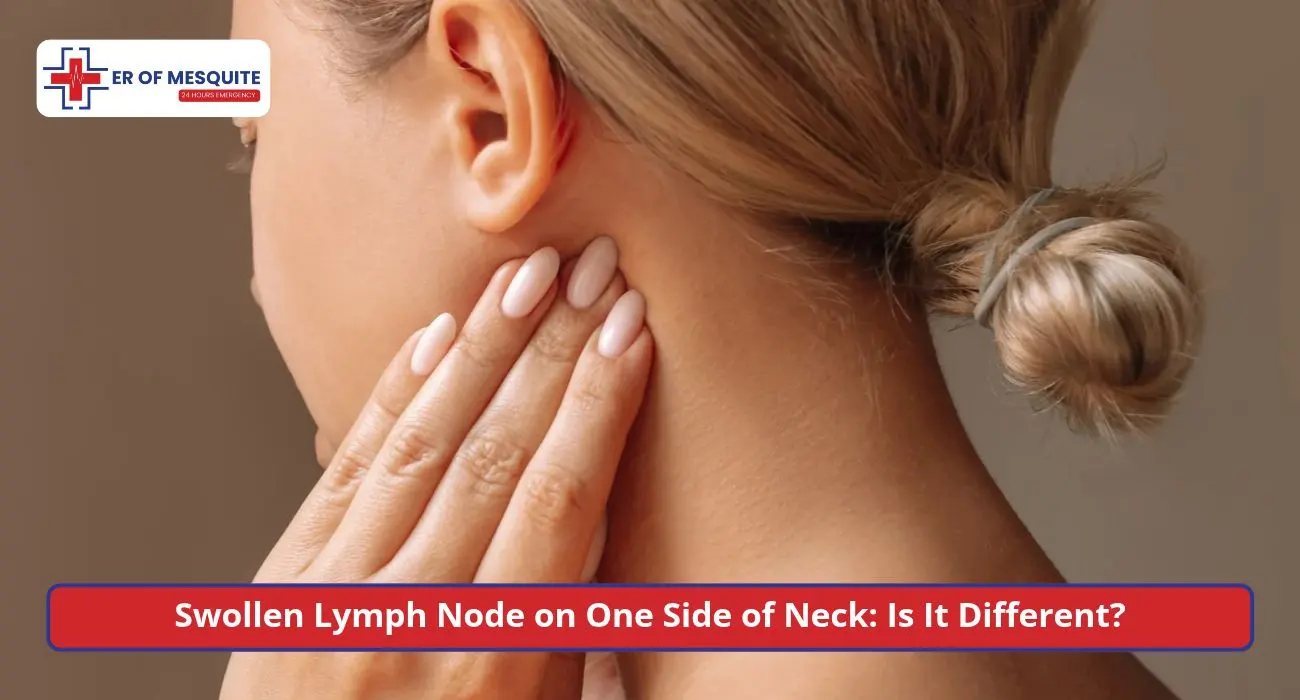
A swollen lymph node on one side of neck usually reflects a local infection on that side: an ear infection, tooth problem, or scalp irritation.
One-sided swelling becomes more concerning when there is no obvious cause, it persists past 2 weeks, the node is painless and hard, or it sits above the collarbone.
Each side drains a specific region. Nodes under the jaw and behind the ear drain the mouth, teeth, scalp, and ear canal.
Nodes along the sides drain the throat and nasal passages. Nodes above the collarbone drain the chest and abdomen, which is why a persistent lump there always warrants evaluation.
Red flags specifically for a one-sided node:
- Steady growth over 2-3 weeks without illness
- Hard, fixed texture that does not move
- Painless lump larger than 2 cm
- Overlying skin changes (redness, warmth, drainage)
- Sits above the collarbone regardless of size
Our pediatric emergency room care team evaluates one-sided neck swelling in children the same day.
When to Worry About Swollen Lymph Nodes
When to worry about swollen lymph nodes comes down to five patterns: persistence past 4-6 weeks, painless hard texture, one-sided without clear cause, supraclavicular location, and association with weight loss, fever, or night sweats.
Any of these calls for prompt evaluation.
Walk in to the ER for:
- Node paired with difficulty breathing or swallowing
- Node with high fever (above 102°F) and spreading redness
- Rapidly growing node over hours to days
- Severe facial, neck, or throat pain
- Signs of sepsis (confusion, rapid pulse, cold skin)
- Voice changes or stridor (airway compression)
Same-day medical evaluation for:
- Node over 1 inch (2.5 cm) persisting more than 2 weeks
- Hard, fixed, painless node at any size
- Supraclavicular node at any size
- Multiple persistent swollen nodes
- Node with unexplained weight loss, night sweats, or fatigue
Per the American Cancer Society, persistent painless node enlargement is one of the most common first signs of lymphoma (American Cancer Society Hodgkin Lymphoma Signs).²
For patients needing rapid same-day evaluation, our full emergency services in Mesquite include rapid strep, blood work, and imaging for neck mass workup.
What ER of Mesquite Does for Neck Lymph Node Concerns
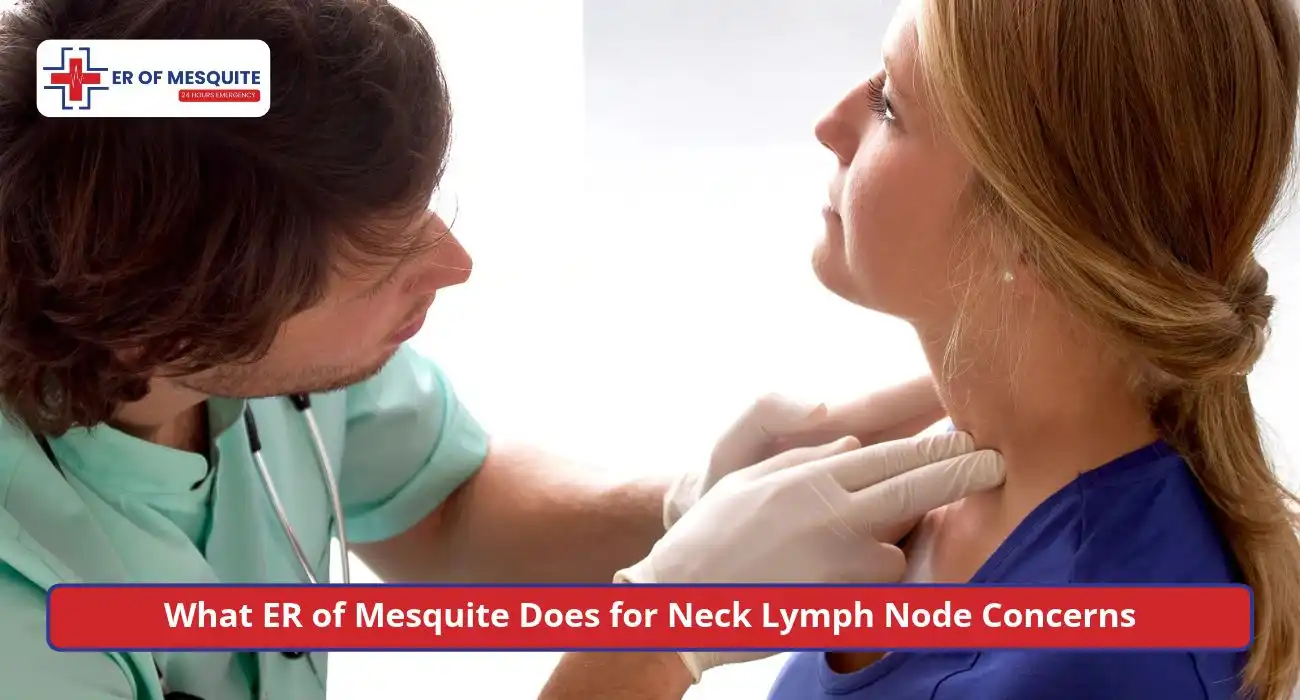
Our ER evaluation starts with a focused head and neck exam, followed by rapid strep and respiratory viral testing, blood work, and imaging when indicated.
For patients with airway concerns or signs of deep infection, we stabilize on-site and coordinate specialist follow-up when needed.
The workup includes:
- Full head, neck, mouth, and throat exam
- Palpation of all cervical, supraclavicular, and axillary nodes
- Rapid strep test and mono screen when infection is suspected
- Complete blood count and inflammatory markers
- On-site digital X-ray or CT when deep infection is suspected
- Ultrasound for distinguishing lymph node from other neck masses
- Coordinated ENT or oncology referral when persistent concerns point there
ER of Mesquite does not perform biopsies or lymph node surgery.
For families new to walk-in ER care, the benefits of a freestanding emergency room include short wait times and on-site labs.
Call 911 Immediately for These Signs
- Difficulty breathing or stridor with neck swelling
- Difficulty swallowing your own saliva or drooling
- Rapid swelling with facial, lip, or tongue involvement
- Severe one-sided neck swelling with high fever and confusion
- Loss of consciousness or severe weakness
- Suspected airway compression
These suggest airway compromise or severe deep infection that needs pre-hospital stabilization.
Location, Hours & Insurance
ER of Mesquite, Cartwright
1080 E Cartwright Rd, Suite 100, Mesquite, TX 75149
Phone: (469) 649-1007
Hours: Open 24/7/365, walk-ins welcome
We serve Mesquite, Balch Springs, Sunnyvale, Forney, Garland, Seagoville, and surrounding communities. We accept most major private (PPO) health insurance plans.
FAQs
What are the most common neck node causes?
Viral infections (colds, flu, mono), bacterial infections (strep, ear infections), dental problems, and skin irritations. Most resolve in 1-4 weeks.
When to worry about swollen lymph nodes?
When to worry about swollen lymph nodes begins at 4-6 weeks of persistence, painless hard texture, supraclavicular location, or weight loss and night sweats.
Should I worry about a one-sided neck node?
A swollen lymph node on one side of neck is often from local infection. It becomes concerning if painless, hard, persistent past 2 weeks, or above the collarbone.
Can neck node swelling be cancer?
Uncommon but possible. Cancer-related nodes are painless, hard, fixed, grow steadily, and last beyond 4-6 weeks. Weight loss and night sweats add concern.
How long is too long for a swollen node?
More than 2 weeks without a clear cause warrants evaluation. Over 4-6 weeks of persistence, or any growth during that time, is too long.
When in Doubt, Get It Checked
Most swollen lymph nodes are simply your immune system working as designed. The ones that need attention stand out for five patterns: persistence, texture, location, growth, and associated symptoms.
If any apply, walk in to ER of Mesquite. On-site labs, imaging, and 24/7 care give you a definite answer within the hour.