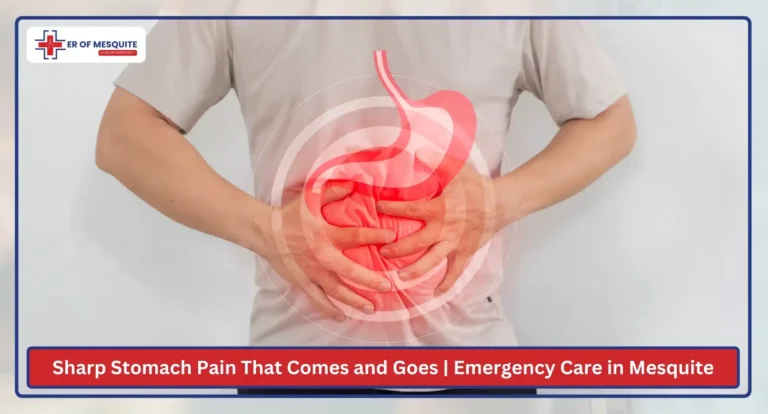
One moment, you are doubled over. Next, the pain is gone, and you are wondering if it is even worth getting checked. Here is the truth: intermittent does not mean harmless. Some of the most serious abdominal conditions, including gallstones, kidney stones, appendicitis, and bowel obstruction, start out coming and going before they escalate. This guide explains the common causes of sharp, intermittent stomach pain and when to walk into the ER of Mesquite for evaluation, 24/7, with no appointment needed.
What the Pain Pattern Tells You
- Colicky pain comes in waves: building, peaking, then easing off, over and over. This pattern often points to a hollow organ trying to move something through it, such as a gallstone, a kidney stone, or a blocked bowel.
- Stabbing pain arrives as sudden sharp spikes without much warning, pointing to nerve-related causes, muscle strain, or specific organ issues depending on location.
- Cramping pain feels like squeezing or wringing, common with gastrointestinal issues, menstrual pain, and some infections.
Why Intermittent Does Not Mean Safe
Conditions like appendicitis, ectopic pregnancy, and bowel obstruction commonly begin as intermittent pain before escalating. The pain-free windows are not an all-clear. They are quiet moments before the next wave. Earlier evaluation catches problems while they are still simpler to treat.
Location Matters: What Each Area Suggests
- Upper right: Gallbladder, liver, or right kidney. Colicky pain after fatty meals classically points to gallstones.
- Upper middle: Stomach, pancreas, or esophagus. Cardiac issues can also cause pain here, especially in women and older adults.
- Upper left: Spleen, stomach, pancreas, or left kidney.
- Lower right: Appendix, right ovary, passing kidney stones, or hernia. This is the region that always deserves attention.
- Lower middle: Bladder, uterus, or lower bowel.
- Lower left: Colon, including diverticulitis, left ovary, kidney stones, or hernia.
- All over: Gas, a stomach bug, bowel obstruction, or, in serious cases, peritonitis from a ruptured organ.
When you walk in, one of the first things our team maps is exactly where your pain is, how it started, and how it has changed. That mapping guides the entire evaluation.
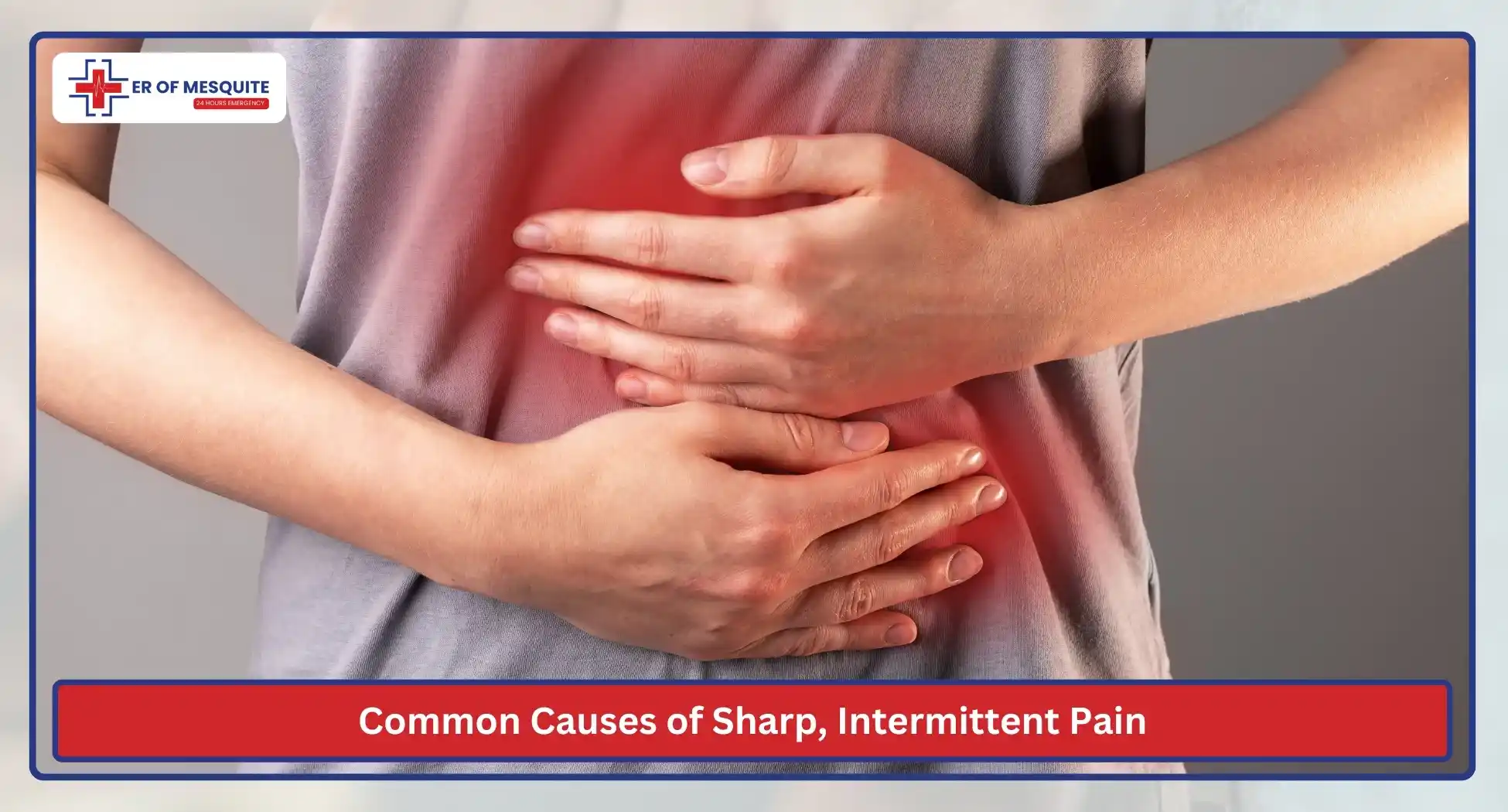
Common Causes of Sharp, Intermittent Pain
Gastrointestinal Causes
Gas and bloating, indigestion and reflux, irritable bowel patterns with changing bowel habits, constipation, food poisoning with cramping and nausea, and ulcers producing sharp upper pain after eating.
Gallbladder and Kidney Causes
Gallstones produce classic colicky upper right pain, often after fatty meals. Gallbladder inflammation adds fever and pain that becomes constant. Kidney stones create severe waves of pain traveling from the back or side toward the groin, while urinary tract infections cause cramping with painful urination, and kidney infections add fever and flank pain.
Reproductive Causes in Women
Ovarian cysts cause sudden sharp pelvic pain, sometimes with rupture. Ovarian torsion, the twisting of an ovary, is a medical emergency. Mid-cycle ovulation pain, endometriosis, and menstrual cramping are all common. The most dangerous is ectopic pregnancy: sharp pain with a positive pregnancy test is life-threatening and needs immediate evaluation.
Appendicitis
Appendicitis classically starts as vague, intermittent pain around the navel, then migrates to the lower right and becomes constant and severe, usually with nausea, low-grade fever, and loss of appetite. This progression is one of the most important reasons to evaluate intermittent lower right pain early. Our emergency appendicitis care team diagnoses and manages appendicitis around the clock.
Bowel Obstruction and Hernias
Obstruction produces cramping in waves, progressive vomiting, a distended abdomen, and inability to pass gas or stool. It is a medical emergency. Hernias cause sharp pain that worsens with coughing, lifting, or straining, with a visible bulge, and become an emergency if the trapped tissue loses blood supply.
When Sharp Stomach Pain Is an Emergency
Walk in immediately for any of the following:
- Pain that shifts from intermittent to constant and severe
- Pain with fever, especially high or rising
- Vomiting blood, bile, or dark material resembling coffee grounds
- Blood in stool or black, tarry stools
- A rigid, board-like abdomen
- Pain that wakes you from sleep
- Pain migrating from the navel to the lower right
- Pain with fainting, dizziness, or rapid heartbeat
- Any abdominal pain during pregnancy
- Inability to pass gas or have a bowel movement
- Yellowing of the skin or eyes alongside pain
- Rapidly worsening pain
Call 911 Instead of Driving For:
Sudden extreme worst-pain-of-your-life onset, a rigid abdomen, vomiting blood, chest pain alongside stomach pain, fainting, signs of shock such as cold clammy skin and confusion, or severe pain in pregnancy with bleeding.
Watch How the Pattern Changes
Because intermittent pain can evolve, the trajectory matters as much as the pain itself. Come in when:
- Intermittent pain becomes constant, often signaling worsening inflammation or infection
- Localized pain starts spreading, which can indicate infection escaping the original area
- Waves are arriving closer together or more intensely with each round
- Pain wakes you from sleep, which is rarely trivial
- New symptoms join the picture: fever, vomiting, jaundice, blood, or fainting
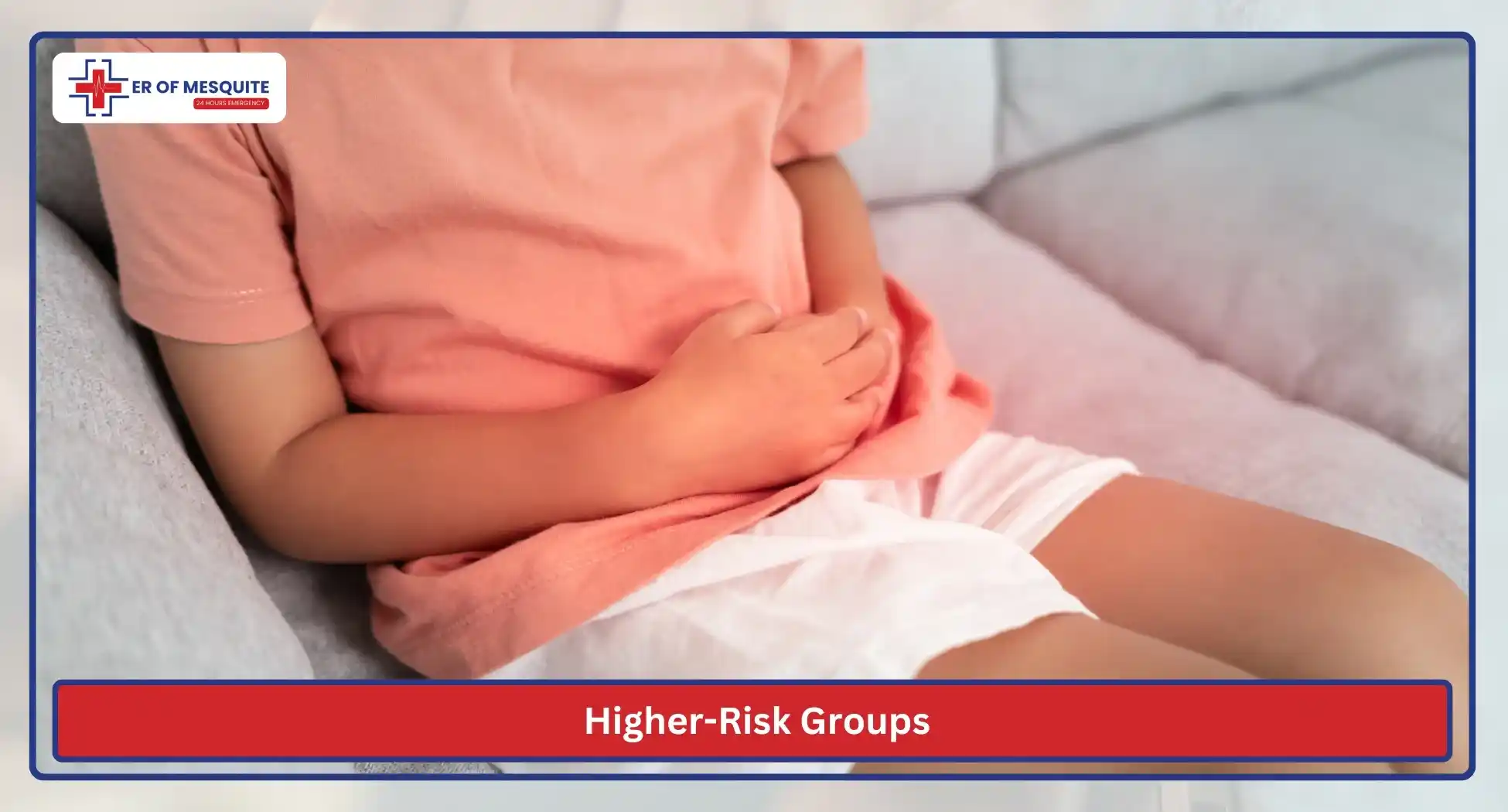
Higher-Risk Groups
Children
Appendicitis is a top cause of pediatric abdominal pain visits, and children often cannot describe pain clearly. A child refusing to walk, curled up, or pulling knees to chest always needs evaluation. In infants and toddlers, bowel telescoping is an emergency, and in boys, testicular torsion can present as lower abdominal pain.
Pregnant Women
Sharp abdominal pain in pregnancy always needs evaluation. Ectopic pregnancy in early pregnancy is life-threatening, and upper right pain with headache or vision changes later in pregnancy needs immediate attention. Pregnancy does not protect against appendicitis, gallstones, or kidney stones.
Older Adults and Immunocompromised Patients
Seniors often show muted symptoms even with serious conditions, and immunocompromised patients may not mount typical infection signs like fever. Both groups should come in sooner rather than later.
Anyone With Prior Abdominal Surgery
Past surgeries can cause internal adhesions that lead to bowel obstruction years later. Pain with vomiting or inability to pass gas means come in now.
How the ER of Mesquite Evaluates Abdominal Pain

You are triaged within minutes of arrival. A board-certified emergency physician performs a full abdominal exam, checking for tenderness, guarding, bowel sounds, and signs of peritonitis. From there, our complete emergency abdominal pain treatment workup happens entirely on-site:
- CT scanning, the gold standard for identifying appendicitis, kidney stones, diverticulitis, and obstruction, with results in minutes
- Ultrasound for gallbladder concerns, pelvic pain, and pregnancy-related evaluation
- Full lab panel including blood counts, kidney and liver function, pancreatic markers, urinalysis, and pregnancy testing when appropriate
- EKG for upper abdominal pain in adults over 40, women, and diabetic patients, since cardiac causes can masquerade as stomach pain
- Observation when the picture is evolving, and coordinated ambulance transfer with stabilization first if surgery or admission is needed
Most patients have answers and a plan within 1 to 3 hours of arrival.
Frequently Asked Questions
Is stomach pain that comes and goes serious?
It can be. Mild causes like gas produce intermittent pain, but so do appendicitis, gallstones, kidney stones, bowel obstruction, and ectopic pregnancy. If the pain is severe, keeps returning, or is worsening, walk in.
Why does my stomach pain stop and then come back?
Wave-like pain typically means a hollow organ is trying to push something through, such as a gallstone, kidney stone, or trapped gas. The organ contracts and causes pain, rests, then contracts again. It is also common with menstrual cramping and early bowel obstruction.
Can gas cause sharp stomach pain that comes and goes?
Yes. Trapped gas can cause surprisingly sharp pain that mimics serious conditions. Gas pain usually resolves within minutes to a few hours and improves with movement. If the pain is severe, prolonged, or accompanied by other symptoms, do not assume it is gas.
How can I tell if it is appendicitis?
Classic appendicitis starts as vague pain around the navel, moves to the lower right, becomes constant and severe, and brings fever, nausea, and loss of appetite. It typically worsens with movement, coughing, or bumps in the car. Appendicitis needs urgent evaluation. When in doubt, come in.
What causes sharp lower right stomach pain?
Common causes include appendicitis, ovarian cysts, ovulation pain, passing kidney stones, hernia, and urinary infections. Appendicitis is the most concerning. If lower right pain is worsening or comes with fever or vomiting, walk in immediately.