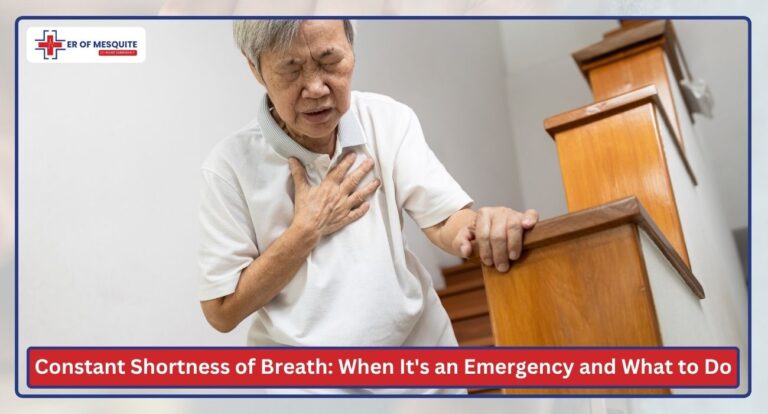
Constant shortness of breath is one of the most concerning symptoms your body can send. It is not the same as feeling winded after climbing stairs or catching your breath after a workout. When breathlessness stays with you at rest, comes on without exertion, or lasts hours to days, it usually points to a real medical cause.
Here is what it can mean, what red flags demand ER care, and when to walk in to ER of Mesquite.
What Does It Mean When Breathlessness Won’t Go Away?
Breathlessness that will not go away means it does not resolve with rest, occurs during light activity, or persists for hours to days. Doctors call it dyspnea. It differs from normal exertional breathlessness because it happens at rest, at low effort, or when you are sitting still.
Dyspnea develops three ways. Acute dyspnea appears within hours to a few days. Subacute dyspnea develops over days to four weeks. Chronic dyspnea lasts more than four weeks and often signals an underlying condition (StatPearls, NIH).
If breathlessness sticks around, worsens with mild effort, or interferes with daily activities, treat it as a medical symptom, not a fitness issue.
Constant Shortness of Breath Causes: What Could Be Behind It?
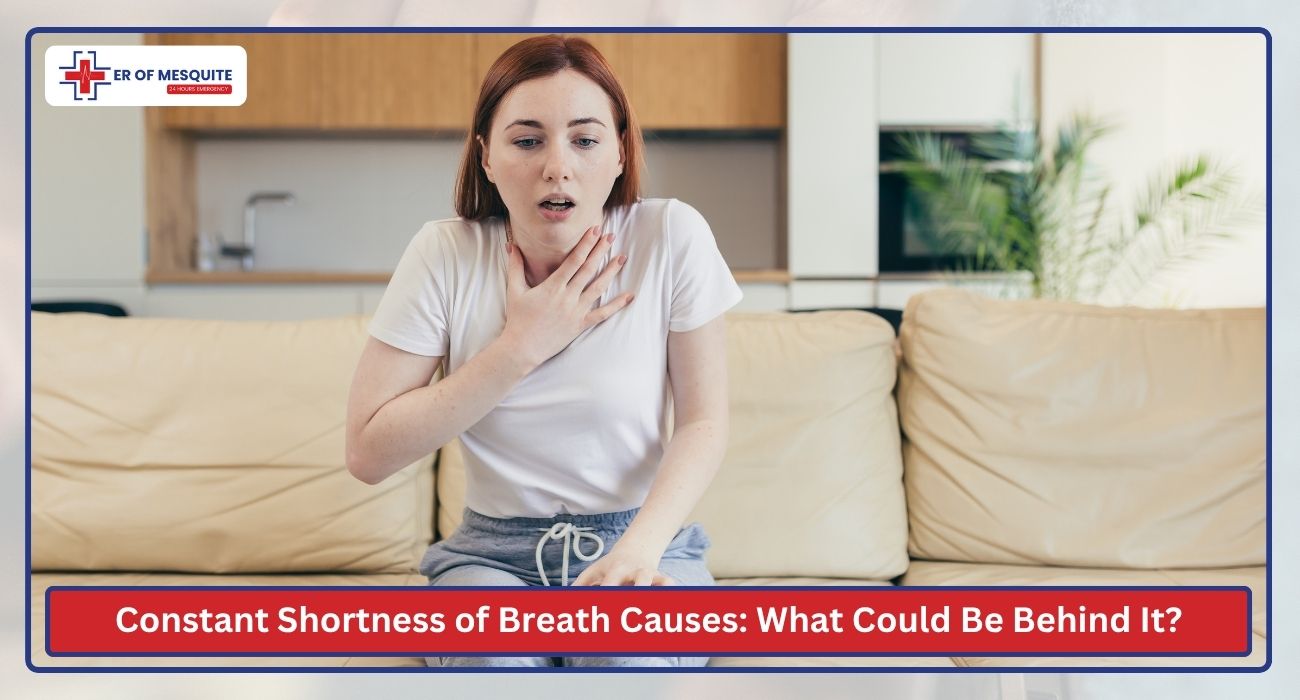
Constant shortness of breath causes fall into four main groups: heart-related, lung-related, blood-related, and other systemic conditions. Heart failure, pulmonary embolism, asthma, COPD, pneumonia, anemia, and severe anxiety are the most common culprits. Each has a distinct pattern, but breathlessness alone cannot tell them apart.
Heart-related causes:
- Heart failure (fluid buildup in the lungs)
- Heart attack (may present with breathlessness, especially in women)
- Arrhythmia (irregular heartbeat)
- Pericardial disease
Lung-related causes:
- Pulmonary embolism (blood clot in the lung)
- Asthma exacerbation
- COPD flare-up
- Pneumonia
- Collapsed lung
Blood-related causes:
- Severe anemia (low red blood cell count)
- Carbon monoxide poisoning
Other systemic causes:
- Anxiety or panic attacks (real physical breathlessness)
- Obesity or deconditioning
- Kidney or liver disease affecting fluid balance
Because these constant shortness of breath causes overlap in how they feel, imaging and lab work are often needed to identify what is really happening.
Shortness of Breath Emergency Signs (Walk In Now)
Shortness of breath emergency signs include breathlessness at rest, chest pain or pressure with it, blue or gray lips or fingertips, confusion, severe dizziness, and inability to speak in full sentences. Any of these means walk in or call 911 without delay.
- Sudden onset of severe breathlessness
- Chest pain, pressure, or tightness with breathlessness
- Blue, gray, or pale lips, face, or fingertips
- Cannot speak in full sentences
- Rapid, shallow breathing
- Wheezing or grunting sounds
- Fainting or feeling faint
- Confusion or difficulty staying awake
- Coughing up blood
- Leg swelling paired with breathlessness (possible clot or heart failure)
- Breathlessness lying flat, requiring you to sit up to breathe
- Breathlessness that wakes you from sleep
The American Lung Association lists chest pain, dizziness, turning blue, difficulty breathing lying down, and leg swelling among the shortness of breath emergency signs requiring immediate care (American Lung Association).
When to Go to ER for Shortness of Breath?
When to go to ER for shortness of breath depends on how quickly it started, how severe it feels, and what else is happening. Walk in for any breathlessness that comes with chest pain, blue lips, confusion, or does not improve with rest.
Walk in immediately for:
- Any sudden severe breathlessness
- Chest pain, pressure, or heaviness with breathlessness
- Blue lips, fingertips, or pale skin
- Breathlessness after a long flight, car ride, or recent surgery (blood clot risk)
- Breathlessness with fever, cough, and chills (possible pneumonia)
- Breathlessness that requires you to sit up to breathe
- Breathlessness paired with leg swelling
- Fainting or extreme fatigue with the breathlessness
Same-day ER evaluation for:
- Breathlessness lasting more than a few hours
- Breathlessness with any new symptom (cough, chest pressure, dizziness)
- Worsening breathlessness in asthma, COPD, or heart failure patients
Contact your primary care doctor for:
- Mild new breathlessness during exercise you did not have before
- Gradual breathlessness with weight gain or medication changes
If you are still asking when to go to ER for shortness of breath in your case, come in. Breathing is not a symptom to gamble with.
Anxiety vs. Medical Shortness of Breath
Anxiety-related breathlessness tends to come with racing thoughts, tingling, and improves with slow breathing. Medical breathlessness from heart or lung causes persists at rest, worsens with mild activity, and often comes with oxygen level drops. Because they overlap, evaluation is important the first time it happens.
| Feature | Anxiety-related | Medical (Heart or Lung) |
|---|---|---|
| Onset | Sudden, tied to emotional trigger | Gradual or sudden |
| Improves with slow breathing | Often yes | Usually no |
| Chest pain | Sharp, brief | Pressure, sustained |
| Blue lips or fingertips | No | Possible |
| Lying flat makes it worse | No | Often yes |
| Oxygen level drop | No | Possible |
| Improves at rest | Usually yes | Usually no |
When the pattern is unclear, walk in. Pulse oximetry and a physical exam can distinguish the two within minutes.
What Does ER of Mesquite Do for a Breathing Emergency?
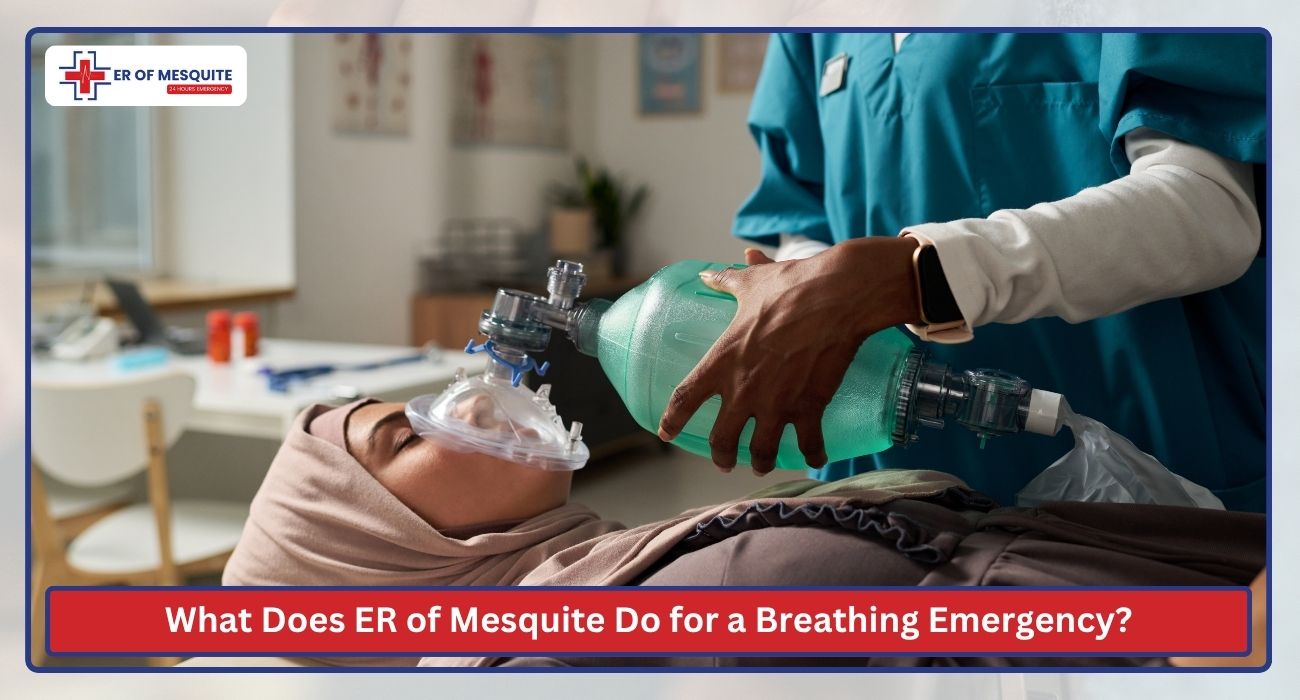
ER evaluation for a breathing emergency starts with pulse oximetry, vital signs, and a rapid physical exam. If needed, our team runs on-site chest X-ray, EKG, blood work, and CT scan to identify heart, lung, or blood clot causes within the hour.
At our emergency room in Mesquite, the shortness of breath workup includes:
- Pulse oximetry and vital signs within seconds of walk-in
- Focused physical exam of lungs, heart, and legs
- On-site digital X-ray of the chest to check for pneumonia, fluid, or collapsed lung
- EKG to rule out heart attack or arrhythmia
- Blood work including D-dimer for clot risk, cardiac markers, and complete blood count
- CT scan on-site if pulmonary embolism or another serious cause is suspected
- Oxygen or breathing support while the workup runs
If pneumonia is the cause, we manage it directly and coordinate follow-up. A similar workup applies when high fever accompanies the breathlessness. For conditions requiring hospital admission, we stabilize and transfer. Learn more about the benefits of a freestanding emergency room.
Call 911 If You Have Any of These
Call 911 immediately for:
- Severe difficulty breathing or gasping for air
- Blue or gray lips, face, or fingertips
- Loss of consciousness
- Chest pain with breathlessness
- Wheezing that does not improve
- Coughing up blood
Do not drive yourself.
Location, Hours & Insurance
ER of Mesquite, Cartwright
1080 E Cartwright Rd, Suite 100, Mesquite, TX 75149
📞 (469) 649-1007
🕒 Open 24/7/365, walk-ins welcome
We serve Mesquite, Balch Springs, Sunnyvale, Forney, Garland, Seagoville, and surrounding communities. We accept most major private (PPO) health insurance plans.
Texas Senate Bill 425 Disclosure: This facility is a Freestanding Emergency Medical Care Facility. It charges rates comparable to a hospital emergency room and may charge a facility fee. This facility, or a physician providing care here, may not be a participating provider in your health benefit plan network. A physician may bill separately from the facility. Under Texas law, your health insurance company is required to process emergency room visits at in-network benefit levels.
FAQs
Is breathlessness that won’t go away always an emergency?
Not always, but it always warrants evaluation. Chronic dyspnea can indicate treatable conditions like anemia or deconditioning, but heart failure and blood clots present the same way. Get checked to know which.
How is breathlessness different from being out of shape?
Being out of shape causes breathlessness during activity that improves with rest. Breathlessness that persists at rest, at low effort, or wakes you from sleep is different, and deserves medical evaluation.
Can shortness of breath be a sign of a heart attack?
Yes. Shortness of breath with chest pressure, sweating, or nausea can be a heart attack sign, especially in women and diabetic patients. Walk in immediately or call 911.
Should I drive to the ER with shortness of breath?
If breathlessness is severe or worsening, do not drive. Have someone drive you or call 911. Even moderate breathlessness is safer riding in with someone else.
What test tells the ER what is causing shortness of breath?
An on-site chest X-ray, EKG, and blood work usually identify the cause within an hour. Pulse oximetry and CT scan add clarity when a heart or lung emergency is suspected.
Don’t Wait Out a Breathing Emergency
Constant shortness of breath is your body’s alarm system. If breathlessness sticks around, worsens with mild activity, or comes with any warning sign, walk in to ER of Mesquite. Fast triage, on-site chest imaging, pulse oximetry, and 24/7 care under one roof.